


Seabirds to Muscat

Updated: Oct 4
This account, written in 1986, captures a sailing passage of two Seabirds from Bombay to Muscat. Nearly four decades later, a similar route returned to public attention with the voyage of the INSV Kaundinya. Sailing from Gujarat to Muscat, the vessel retraced ancient maritime links between India and Oman, reviving traditions that go back centuries.
Whether in a small Seabird in 1986 or a traditionally built sailing vessel today, the act of crossing the Arabian Sea remains a test of judgement, skill, and endurance.
At Meluha Maritime, we believe such accounts, personal, understated, and rooted in experience, are essential to understanding India’s maritime past and present. We are pleased to carry this piece as part of that effort.
The ultimate dream of every sailor is to make an ocean passage at least once in their lifetime. When Jehangir Jehangir (JJ) got the idea of doing something like that, all he had at his disposal was Jaeger, a 21’ Seabird. For a Seabird, the Arabian Sea was as good as an ocean since it had no cabin neither a roof nor a bunk and not even a toilet. After JJ had got a glimpse of Muscat some two years back, he began toying with the idea of sailing there. JJ claimed that the Seabird was a very safe boat capable of doing an open sea crossing. The Army had made a voyage to Bandar Abbas in a Seabird but only by being close to the coast. JJ wanted to prove that we could do an open sea crossing in the Seabird. The sailor who had first subscribed to JJ’s idea was Sheri Bamboat, followed by Adi Tarapore and the Late Colonel Tim Divecha. Hakim Sabir and I were the next to join the team and Raman Narayan was the last, who replaced Colonel Divecha whose sad demise was very untimely. The final team was as follows:-
JAEGER
Skipper | Jehangir S. Jehangir |
Crew | Adi E. Tarapore |
Raman Narayan (Billoo) | |
Sadanand Chunekar |
SANDPIPER
Skipper | Cyrus N. Heerjee |
Crew | Sheri F. Bamboat |
Hakim S. Sabir | |
Madhu Kulabkar |
The following organisations / persons part-sponsored us:
Air India
Goodlass Nerolac
Ciba Geigy
Dr. N. P. Tolani
Mr. J. N. Godrej/ Godrej & Boyce Mfg. Co. Ltd.
Mr. K. V. Mariwala
A voyage of a thousand miles begins with a single step. The initial discussions and planning began in May 1985, which meant over six months of preparation. There were many hurdles and obstacles, two main ones being finding the second boat and obtaining the visas to Muscat.
Mr. Kishore Mariwala, an ardent sailor from the Royal Bombay Yacht Club (RBYC), was most generous in lending us his sturdy boat SANDPIPER – a most magnanimous gesture, for a voyage so long and hard on a boat. The visas finally arrived through the efforts of Mr. Jamshyd Godrej. The business of preparing the boats, fitting out, planning what to store and where in the required quantity was great fun and most enjoyable. Today the fun and frolic of youth looks so much in the distant past. We studied navigation using a sextant on our own and even went on a small rehearsal run to see how the equipment worked and how the boats behaved with that much of a load.
“CRUISING IS TO SAILING AS FEASTING IS TO EATING” – We worked really hard taking care of the minutest details. Better the planning and preparation, better was the result, and it surely paid off in our case.
Finally on the 7th of February 1986, after a lot of fanfare at the Gateway of India, with the popping of champagne bottles, rising balloons and a dozen cameras clicking, the expedition got underway.
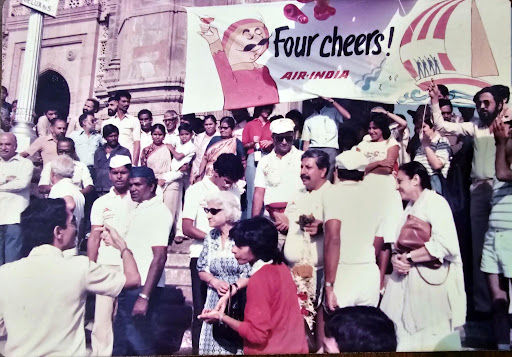


SANDPIPER and JAEGER slipped moorings and sailed out of the harbour accompanied by an escort of friends from the Colaba Sailing Club, RBYC and BSA sailing in Lightnings, Lasers, Enterprises and Seabirds all the way up to the Prongs Light House waving goodbye.


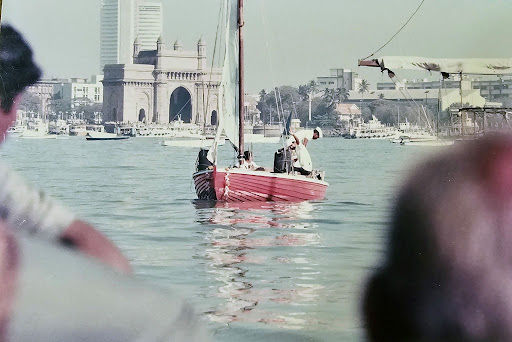
We set sail on a cloudless sky and a crisp northwesterly, leaving behind the Bombay skyline sailing westward towards the hazy sun setting in the sea.
It only hit us next morning at dawn, when the first light broke, and we put our heads out of the sleeping bags that we could see nothing except the lonely looking sea and sky all around, not even a bird or a ship on the horizon to wave at. We were either going to reach Muscat or go bust!


On Sandpiper, we took watches of four hours each at night, Sheri and Madhu took the first watch after sunset and Hakim and I the second.
Madhu kept complaining that he could never get sleep because Hakim and I were chewing on banana chips and nuts throughout the night, the sound of which was too disturbing and reminded him of home where pigeons at the Gateway did nothing but munch all day long.
I was the ‘navigator’ who got the noon fixes with a sextant whilst Sheri, the ‘Chief Cook’ would fix the breakfast and the lunches. Dinners were light, just soup and biscuits or ‘leftovers’ from the lunch. We used to enjoy our breakfasts the best until the eggs ran out and we had to make do with powdered eggs, which tasted yucky.

Bathing was on the fore deck with plenty of sea water. One mug of fresh water at the end to rinse off the salt was a true luxury.
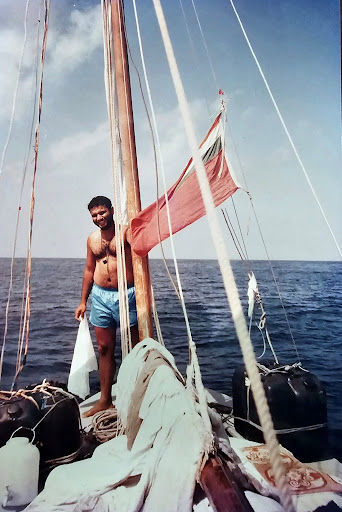
One of the highlights on the 4th day at sea was spotting a whale or something as big and then on another day catching a nice big fish but throwing it right back into the sea as we were not sure if it was the edible type. We celebrated Hakim’s and my birthday during our first week in the sea with special meals cooked by Sheri and raised a toast with tiny sips of good ole rum.

For the first eight days, we had light to moderate head winds and were hence beating most of the time. Our plan had been to sail north initially, to skirt Bombay High, head towards Diu and then straight westward to Muscat. On the ninth day we ran into unimaginable flat calms. The sea was like a sheet of glass, not a ripple for miles on end. This went on for three days and nights. At night every star reflected in the water. The phosphorescence was too beautiful for words – it would light up our sails and faces. We had enough fuel and we motored across for three days.


On the tenth day, we began to get a following wind and made good ground with our spinnakers flying. The next day things began hotting-up. The wind picked up and the seas began building up. The sky was overcast and black clouds flew in low overhead. We reluctantly poured the hot soup, just cooked, overboard before the rain and 30 knot winds lashed us for an hour or so, tossing us wildly on a raging sea. We sailed through on double reefed main sails. By evening it was peaceful again and we had to use our engines at night.
The next day, we had fair weather again. We made contact with an Italian tanker and confirmed our position, we had only 250 miles to go. That night the wind and sea began building up once more. Black clouds were racing past us all night. We brought down our mainsails and sailed on only on our jibs. By morning the wind had swung around 180° and we were facing head winds. The horizon in the direction of Muscat was full of black clouds. This was day 13. Around mid-day menacing black clouds with the ‘shamal’ came hurtling towards us from the direction of Muscat. The storm hit us in all its fury. We brought down our jibs too and turned our boats around, and sailed with the storm on bare poles away from the Oman coast back towards home. The wave height was over 30’ and the speed of the wind was around 35-40 knots. We had used up most of our water, fuel and provisions so were quite light and the Seabirds behaved perfectly, riding each wave. The rain lashed us for over an hour. We were continuously bailing out the rain and the sea water which kept pouring in, to keep us from floundering, a back breaking job which we all shared. The waves were so high, when we were in one trough, Jaeger went completely out of sight in another.
SANDPIPER had more windage (because of our canopy) than JAEGER and began moving away faster even on bare poles until the boats were soon out of sight of each other. During the storm a massive tanker approached us and we fired our flares to warn her of our position and then we made radio contact to ensure that she had seen us. By evening the storm abated and we were able to hoist jibs and find each other. We sailed on the reverse bearing hoping that Jaeger too was doing the same heading back towards the Oman coast, our destination.
This was the first time we had lost sight of Jaeger and it was a terrifying feeling, not knowing whether we should continue sailing on the course to Muscat or keep going in circles searching for Jaeger.
But by then our VHF radios were dead and there was no way to make contact with each other. We sailed on the bearing when we had last sighted JAEGER and thank God we did find her bobbing in the distance sailing on jib alone.
If we had not spotted her it would have been a nightmare trying to decide whether to keep searching or carrying on towards Muscat in the hope that they were on the right course sailing to Muscat and not going around in circles searching for us.
That night we had a little peace but next morning it was blowing like crazy again.
Land Ho! We were 60 miles south of Muscat and sighted land at the crack of dawn and the Oman coastline and hills were one of the most comforting and magnificent sights for as at that point in time. . But our trials were by no means over. We had 30 knot northerly head winds again which the Arabs call as the deadly Shamal, funnelling onto us through the famous “Devil’s Gap”. We tried to hoist our mains, double reefed and beat up the coast but we were getting blown over. The seas were massive, we had to keep an eye on every single oncoming wave to make sure that we climbed it and did not get swamped. Our hands were giving way struggling with the tiller and the main sheet. Then as discretion proved the better part than valour, we sailed on jibs alone, but our tacking angle was some 180° and it was impossible to make ground north. When we tried moving on the outboard motor, the prop would come right out of the water as our stern were lifted right up over a wave, Finally in the afternoon, we gave up the idea of beating up and decided to sail down the coast and seek shelter till the “Shamal” blew itself out. There were only two places marked in the Pilot where there was some shelter from a north westerly. We managed to find one of them and sailed towards the spit. Hordes of villagers came out of their houses waving towards us and running down the beach guiding us to a cove where there was shelter. We were surely relieved to anchor there after four days of rough weather and fourteen days at sea.

The next morning saw us on calm weather without an ounce of wind. We could not believe our eyes. It looked like a different world. We pulled our engines to life and raced up the coast and were in Muscat by 2100 hrs. We anchored in ‘Mina Qaboos’ and tried going ashore only next morning.
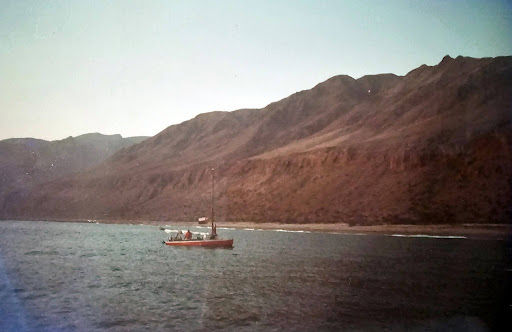
The immigration and Customs Officials, who intercepted us and came aboard, looked at us disbelievingly, thought and said we were plain crazy to have sailed in from Bombay on boats like that, They were used to large visiting yachts and no one had ever sailed in such little, cabin-less boats ever before into their harbour.
They first objected and protested that we sailed in without making radio contact but quietened down when we showed them our water soaked VHF radios.
Then what they said really scared the wits about us. There were 15 to 20 fishermen who had gone missing lost in the recent storms and ‘shamals’ which we had gone through and had managed to survive.
The first thing we did when we got ashore was to call the Godrej Company in Bombay to say that we had reached and to request them to inform our families who hadn’t heard from us for the last 15 days.
We had quite a hero’s welcome in Muscat, including a Reception by the Ambassador at the Indian Embassy with a press conference organised for us.
We were greatly helped by Oman Fisheries and Genetco who sponsored our trip back. We spent five very relaxed days before the loading up began again.
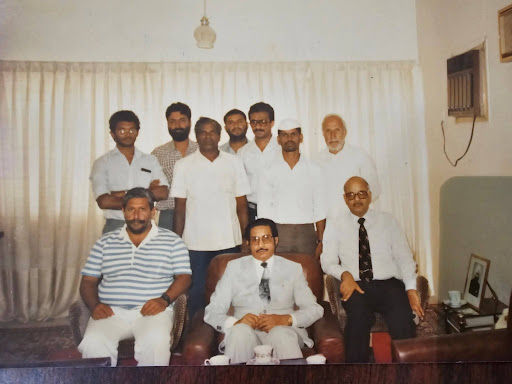

The Return
Adi Tarapore and Hakim Sabir dropped out and Rajeev Parab joined us in Muscat for the trip back. The voyage was comparatively uneventful. We did wonder at our luck when we had head winds again while sailing out and then absolute flat calms for four days as we cut across on engines. Then our fortunes changed and we got fresh following winds on which we hoisted spinnakers and raced across the Arabian sea. If the wind dropped, we would put on our engines to make time and recharge our batteries. We had so much wind suddenly that it was a problem to charge our batteries – no opportunity to put on engine. We began covering 130 miles a day. We hit Bombay High on the seventh day and that confirmed our course. The oil rigs looked like something out of this world, more like an endless Space Station so brightly lit against the black night sky. The next morning of the eighth day we had the high-rise buildings of Bombay and then Prongs Reef smack on our bows. By afternoon we were back home at our moorings. The return voyage took half the number of days with just one freak wave that came over and drenched us. A very peaceful trip indeed.
To sum-up, I would just like to say hats-off to Mr. Morgan Giles who designed the Seabird and I wish he was there to see us doing an open sea crossing. Our successful voyage was mainly because we took great trouble in the boat preparation and planning, we carried sufficient spare rigging which we used as soon as we noticed any deterioration on the original and we were able to work as a team knowing our limits and also the boat’s. We did not take any undue risks and safety was of paramount importance.
But, for the time factor as these trips take so long, I am sure all of us would do something like this again.
An open sea crossing has a charm of its own, there are moments of pleasure and pain, boredom and excitement, humility and triumph, terror and tranquility, and it goes on and on, one experience after another and you come out a much better and stronger person.
And then whenever you are accosted by bad weather and difficult situations, you think back on how you made it through the stormy seas and reached Muscat successfully and you say to yourself “this is nothing like what we went through then, we survived all that and so we shall overcome this too."
Cyrus Heerjee
30th April 1986
Photographs post-production: Viraf Hansotia
Cyrus Heerjee is a veteran Mumbai-based sailor, sailing instructor with almost 50 years of experience in the sport. A celebrated racer, he has won national events in Seabird, Lightning, and Enterprise dinghy classes and undertaken voyages to Goa, Maldives, and Muscat on a 21-foot Seabird without GPS.
He founded Fair Winds Sailing School in 1978, one of Mumbai's oldest institutions for teaching sailing to novices, and has trained more than 500 sailors using his unique syllabus. A member of the RBYC since 1983, he has held different positions, such as Commodore, Hon. Sailing Secretary, Captain of Boats and Vice President.
Now around 76 years old, the Colaba resident embodies traditional seamanship, promoting yacht racing and weekend events and continues inspiring the Mumbai sailing community.
Disclaimer: The views and opinions expressed in this article are those of the author.



Wow! What a courageous and suspenseful journey it has been! Admire the bravehearts like you who have made maritime history interesting! Bravo!! 🙏🏽🙏🏽