


An Engineer, a Son and the Indian Navy
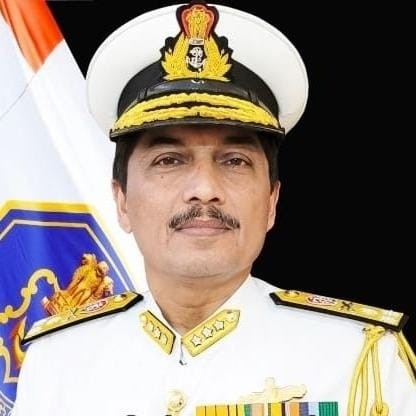
This week’s Maritime Musings is a personal account by Vice Admiral Sandeep Naithani of his father, Shri Sanat Kumar Naithani, an engineer whose career was closely associated with the development of India’s naval infrastructure. Publishing it on Engineers’ Day (15 September) gives us an opportunity to remember the engineers and technical professionals whose work, often unseen, has helped build and sustain the Indian Navy.
Every Navy is remembered for its ships - the carriers, destroyers and submarines that sail the newsreels and the histories. But every fleet also depends on a quieter, less visible navy ashore: dry docks, slipways, workshops, jetties and hangars. These are the places that let ships return, repair, refit and sail again.
My father, Shri Sanat Kumar Naithani, belonged to the generation of engineers who built that Navy ashore. And, in a way I did not foresee as a child, his life and work would become the foundation of my own.

A young Roorkee engineer
He was born on 15 September 1936 in Dehradun, with roots in Naithana village, Pauri Garhwal. He graduated in Civil Engineering from the University of Roorkee in 1959, did his post graduation in Structures and then taught structural engineering there for four years before joining the Military Engineer Services (MES).
He was an engineer in the old-fashioned, best sense: fascinated by behaviour and detail, and happiest when drawings and calculations became something solid under the sky. His research into foundation engineering — particularly bored piles under cyclic loading and empirical methods for friction piles — earned recognition in technical circles. The “Naithani Method” became a phrase among practitioners, and his papers appeared in the Indian Geotechnical Journal.
But he measured success differently. Academic citations mattered less to him than standing at a finished site and seeing a structure do its work.
Visakhapatnam, 1969
In 1969, he was posted to the Directorate General Naval Projects (DGNP) at Visakhapatnam. The Eastern Fleet was expanding and the dockyard was being built almost from scratch. Engineers, officers and workers were creating infrastructure that a modern navy could rely on — and my father was among those pioneers working with Soviet engineers.
He often spoke of the slipway he designed for the Naval Dockyard. He also remembered the Soviet engineers who worked alongside Indian teams, particularly an E. Karpov from the Leningrad school. My father admired not only Karpov’s technical skill but the discipline and method he brought to engineering. So enamoured was he that, years later when posted to Chandigarh, he enrolled in a Diploma in Russian at Punjab University — not because anyone asked him to, but because he wanted to learn the language of a professional tradition he respected.
An early lesson in war and service
I was eight in 1971 when war came to Visakhapatnam. For a child, its presence was domestic ritual: sirens, blackouts, conversations full of hushed seriousness. One morning explosions shook our windows — later we learned of the sinking of PNS Ghazi. A naval doctor we knew took our family aboard INS Nistar and showed us divers’ photographs from the wreck. I remember those images the way children keep vivid, mysterious pictures: life jackets, torn metal, evidence that the world we took for granted could be fragile and perilous.
My father received the Poorvi Star for his service in the operational area during that period. As a civilian MES engineer he could not wear it as a military decoration, yet he treasured it. Even then I sensed the difference between battles fought at sea and the work ashore that makes those battles possible. He had not fired a weapon, but he had built and maintained the foundations without which the Navy could not fight.

A chance meeting on a train
One story my father loved telling took place years later, when he was overseeing construction of Surya Dock in 1981–82. Returning to Visakhapatnam by the Godavari Express, he shared a first-class coupe with an elderly gentleman. Like most Indian trains, conversation flowered.
They spoke of work and family. The gentleman said he was travelling to visit his son. At the station a young man came to receive him and respectfully touched his father’s feet — a gesture my father noticed without registering significance. Only later did he learn that the young man was Rear Admiral Sukhmal Jain, then Fleet Commander, Eastern Fleet, and the elderly gentleman was Shri Sant Lal Jain.
A week later, the Fleet Commander himself arrived — not in uniform, but as a son who wished to thank the man who had been kind to his father on a train. The staff car outside our house drew neighbours’ attention. There were no formalities; only human warmth. My father loved that episode because it had nothing to do with rank or calculation. It was, simply, decency meeting decency.
The dockyard as memory
He returned to Visakhapatnam again in 1980 as Garrison Engineer, Dry Dock, and later designed the Matsya Dock. The slipway he had created, the Surya Dock he had supervised, the Matsya Dock he had drawn — the same places traced different stages of his life. Years later, when I was posted to Visakhapatnam as Additional General Manager, Planning, I walked through the dockyard with him. He could still recite dimensions or widths of Matsya Surya Varuna — “16 metres, 21 metres and 42 metres” — the way some people remember melodies. For him, an engineer, work was remembered in measures.
Beyond Visakhapatnam
His projects took him far beyond a single harbour. In Delhi in the 1960s, he designed the Western Naval Command Officers’ Mess in Mumbai. In the late 1980s and early 1990s, as Chief Engineer, Design and Consultancy, he worked on demanding projects: the large-span Tu-142 hangar in Goa and an auditorium in Chanakyapuri that needed to respect the civic and architectural sensitivities of Lutyens’ Delhi. Years later, when I served in Goa as Chief of Staff (Technical), I took him to see the Tu-142 hangar. There were no speeches — only a quiet visit, an engineer looking at a building he had helped bring into being.
From engineer to admiral
I cannot point to a single moment that sent me into uniform. The Navy was simply threaded through my childhood: the blackouts of 1971, photographs of Ghazi, dockyard talk at the dinner table. My father’s life made the service familiar and tangible. Many years later I had the privilege of serving as Director General Naval Projects, Mumbai, in the rank of Vice Admiral. My father was quietly proud. He would say, with the modesty of a man whose identity was work rather than accolade, that perhaps I was the first three-star admiral to have come from what he fondly called the “MES fraternity.” Whether formally recorded or not, that recognition mattered to him because it was personal: a son continuing a professional thread he had once helped weave.


The dry dock that closed a circle
During my tenure as DGNP Mumbai, the Navy’s largest dry dock was commissioned by the Raksha Mantri. My father stood there with me. Decades before, he had been a young engineer helping build the shore infrastructure of an emerging fleet. Now he watched his son lead the organisation responsible for the next generation of that infrastructure. The ships had grown larger, the technology more complex, but the truth remained: a fleet at sea depends upon a Navy ashore, and a Navy ashore depends upon engineers.


The quiet builders
My father passed away on 14 May 2023, at 86. He left behind academic papers, design drawings and buildings, but those are not the first images I carry. I remember him walking through dockyards, recognising a slipway, reciting dimensions, looking at a hangar he had once drawn. His work was largely invisible to the public; that is the nature of engineering. A ship sails and draws attention. A dock receives it, receives the fleet home, enables repair, refit and renewal.

He built foundations that served long after he was gone. In small, unobtrusive ways, he also shaped the course of my life. Between us were two generations, different in rank and duty but joined by the same institution and the same ethic of service. Perhaps the greatest legacy an engineer can leave is not a plaque or a named building, but something that continues to serve — silently, reliably — for decades.
Dedicated to my father, Shri Sanat Kumar Naithani, on his birthday, 15 September — Engineers’ Day in India.

Vice Admiral Sandeep Naithani
Vice Admiral Sandeep Naithani, PVSM, AVSM, VSM last served as the Chief of Materiel, the Indian Navy’s senior most technical officer and Principal Staff Officer responsible for all engineering, electronics, weapons, and IT systems on ships and submarines.
Commissioned into the Electrical Branch on 1 January 1985, he is an alumnus of NDA, IIT Delhi, DSSC and NDC.
Over a 39‑year career, he commanded INS Valsura, served on board INS Viraat, held key dockyard and technical roles in Mumbai and Visakhapatnam, and advanced through appointments such as Admiral Superintendent, Naval Dockyard Mumbai, Director General Naval Projects, and Controller of Warship Production & Acquisition before assuming charge as Chief of Materiel on 1 June 2021 to lead the Navy’s modernisation, indigenisation, and infrastructure development.


What a lovely tribute. Engineering is the Silent Silent Service of the Forces. Anurag
Mr Naithani was great designer with lots of knowledge. I met him when he was GE for construction of dry dock as Vizag. His honesty, knowledge, dedication to work and simplicity gave me confidence and encouragement to prefer design and remain continued association admiring him for very long period even after is retirement.
I had the good fortune to work as GE WS&AC , Delhi Cantt under the tutelage of Mr SK Naithani , who was the Addl CE in Delhi Zone. A fine gentleman and officer, he was an able leader and support in the otherwise cut throat world of professionalism.
An accurate account of his achievements from his able and devoted son, made interesting reading and brought back fond memories of my association with the great personality
Remembering Mr SK Naithani , my boss during my younger days when I worked with him for dry dock project of DGNP Mumbai and learnt the initial steps of engineering design of Dockyards - Arvind Arora, former DG(pers) MES . Salute to the visionary
Sunil Waghamare
An excellent write up and a great tribute to great Engineer and a nice gentleman. I had the preveledge of working with him during my earlier career in MES and learnt the ABC of structural design from him. My close association with him for two years decided my future course in MES.