


From ‘Bridges of Friendship' to ‘United through Oceans’ – Indian Navy's IFR journey
- Cmde Srikant Kesnur

- Feb 1
- 11 min read
Updated: Feb 5
(Author's note: This article was originally written by Cmde Srikant Kesnur in 2016 following the International Fleet Review, for the Centre for Policy Studies, Visakhapatnam. As part of our build-up to the upcoming Fleet Review and MILAN, we are revisiting and sharing select writings that capture the spirit, scale, and significance of these maritime engagements.)
The culmination of the International Fleet Review (IFR) 2016 on 08 Feb with a spectacular multi-nation band concert brought the curtains down on a week of high voltage activity that characterized what was, arguably, India’s biggest maritime event. The numbers by themselves are staggering – almost 50 countries including 22 Chiefs of Navies, 26 delegations and 100 warships including 24 foreign men of war took part in this multi-hued extravaganza at Visakhapatnam, on India’s east coast that also saw more than a million spectators or footfalls. While marked by the pomp, pageantry, ceremony, precision and colour that invariably accompany such occasions, the IFR also had several takeaways in the political, diplomatic, military and civil society spheres. While analyzing all of them would constitute separate essays, a brief overview of the event may provide us some broad brush picture of the large canvas that was the IFR.

Historical Overview and Event Highlights
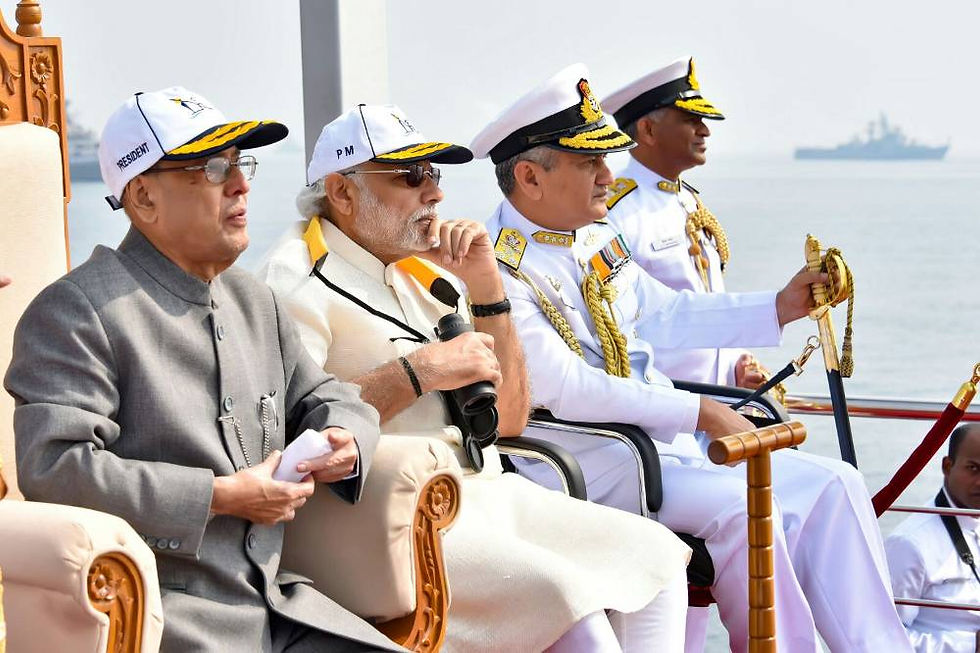
Historically, a Fleet Review is an assembly of ships at a pre-designated place for the purpose of paying respects to the sovereign of a nation and to display their commitment to him. In turn, the sovereign by reviewing the ships reaffirms his faith in the fleet and its ability to defend the nation’s maritime interests. In our country, the President of India, as the Supreme Commander of the Armed Forces, reviews the Fleet. Over a period of time Fleet Reviews in India have seen participation by ships, submarines and aircraft to emphasize the three-dimensional nature of the Indian Navy. Ships of the other government agencies such as the Coast Guard, government research vessels and Indian owned (flagged) merchant ships have also joined in paying respects to the President.
It is possible that our early maritime kingdoms such as the Cholas or Kalingas may have had their own versions of the Fleet Review given their oceanic excursions and endeavours. However, the earliest recorded Indian Fleet Review was in the 18th Century by the powerful Maratha Fleet consisting of ‘Ghurabs’ and ‘Gallivats’ under the renowned Sarkhel (Grand Admiral) Kanhoji Angre at the coastal fortress of Ratnagiri. In Britain, a Fleet Review was a precursor to setting sail for war or was conducted on special occasions like the coronation of a new monarch. In the USA, the ‘Great White Fleet’ meant to project American power overseas was reviewed by President Theodore Roosevelt in 1907, prior to departure, and once again in 1909, on its return to the United States.
Independent India had witnessed ten Fleet Reviews prior to this year’s edition, with the last one held on 20 December 2011 in Mumbai. This included the first ever International Fleet Review in 2001, which saw large participation from foreign and Indian ships. The eleventh review in Visakhapatnam, thus, was the second International Fleet Review hosted by India. During the review, the President is received by a Guard of Honour prior to embarking the Presidential Yacht. This is followed by a 21-gun salute, after which the President, onboard the Presidential Yacht, steams past an armada of anchored ships from the various theatre Commands of the Indian Navy along with ships of the Indian Coast Guard and Merchant Navy. In addition to the anchored ships, a mobile column of warships steams past the Presidential column, offering similar salutations. IFR-16 also witnessed warships, sail ships and delegations from friendly foreign nations joining the ceremony and the accompanying festivities.
Shri Pranab Mukherjee, President of India, Shri Narendra Modi, the Prime Minister, Shri ESL Narsimhan, the Governor of Andhra Pradesh, Shri Manohar Parikkar, the Raksha Mantri, Shri Chnadrababu Naidu, the Chief Minister of Andhra Pradesh and other high Indian dignitaries, along with the naval heads of the participating nations attended the Fleet Review on 06 Feb, with collateral activities conducted from 04 to 08 February 2016. Apart from the Review itself, the mega event had a variety of programmes like the Maritime Exhibition that displayed our maritime heritage and technological achievements, an IFR Village that showcased India’s cultural heritage along with entertainment performances and food stalls with multi-cultural cuisine, the International City Parade that witnessed men and women from many nations marching past in colourful attire, joint international band concerts, an International Conference that saw cogitation on matters academic and above all a high tempo operational demonstration on RK Beach – in all an extravagant show that guaranteed something for everyone.
Indian Navy, our Maritime Roots and the Genesis of IFR
It is often said that India is a young nation but an ancient civilization. Quite the same analogy can be drawn for the Indian Navy. It is a young service but imbued with a long and a glorious maritime heritage. Thousands of years before other parts of the world witnessed maritime activity, the Indian Ocean was a busy thoroughfare with India as its hub. An enduring relationship with the oceans had been established from as far back as the 3rd millennium BCE. Our hoary maritime past not only witnessed great feats in seafaring and ship building eons ago but also was informed by a vision that saw the world as one entity (Vasudhaiva Kutumbakam) strengthened by bonds of friendship, nurtured by trade and nourished by cultural exchanges. Closer home to the East Coast, the Bay of Bengal was a highway for many kingdoms in southern and eastern India such as Pandyas, Cholas, Kalingas, etc. to embark on cultural and commercial missions to lands all the way to Pacific Ocean. While the second half of the last millennium saw a decline in this maritime spirit, we picked up the threads in right earnest soon after independence with the Indian Navy as the main embodiment not only of our maritime prowess but also of maritime thought. Thus, India’s rich maritime past was characterized by an amazing range and depth of civilisational exchanges in an informal rule-based system that encouraged both commercial and cultural endeavours. The same impulses now mark our maritime outlook and our commitment to global peace today while adapting to the imperatives of current international landscape.
Post-Independence, in 1947, the Indian Navy, in acknowledgement of its maritime moorings, began to build up from a small entity it then was. Today, it is a truly global Navy – with a balanced force that includes modern ships including aircraft carriers, submarines and high performance aircraft - and is widely acknowledged as a professional three dimensional maritime force capable of undertaking several roles and discharging multifarious responsibilities. Over the last 25 years, the progress of the Indian Navy has been concomitant with the rise of India in the political, economic, diplomatic and technological spheres. This rise has been premised on the principles of peace, harmony, mutual co-existence and respect for universal values that have been at the core of India’s beliefs. The Indian Navy has not only inculcated these values but has also been in the forefront of strengthening them through the common medium of the seas.
In an increasingly globalized and inter-connected world, India’s national policies have emphasized cooperative international relationships for greater prosperity and well-being of not only of our citizens but humanity at large. The world of today is equally one of unprecedented opportunities and grave challenges. India’s approach to increasing regional and global issues has been to build bridges of friendship with all the nations, with the Indian Navy as the principal instrument, to support our foreign policy efforts, in the maritime and security domains. Our approach to the global commons has always been one of seeking shared prosperity and security. In this endeavour, all the maritime nations of the world are our most indispensable partners in meeting many common challenges.
Against this background, the International Fleet Review (IFR) 2016 could not have come at a more opportune moment. IFR-16 was thus aimed at further broadening maritime engagement between India and the other foreign navies while providing renewed impetus and momentum to our global maritime partnerships. In the run up to the event, the objectives were aptly enunciated by Admiral RK Dhowan, the Chief of Naval Staff, who said,
“The hosting of the International Fleet Review (IFR) by the Indian Navy in February 2016 can be seen as a significant event in the nation’s maritime history. While showcasing our navy to the nation and to the Honourable President of India we also celebrate the time-honoured principles of friendship across the oceans, which are intrinsic to the seafaring community. The IFR serves to provide a platform for participating navies to interact with each other, strengthen bridges of friendship, towards developing a common appreciation of maritime challenges and the potential for addressing them through a united approach. This is in line with India’s overall policy of strengthening cooperation amongst nations to meet common maritime security challenges and to render the ‘global commons’ safe and secure'. The coming together of many navies will be accompanied by several events and functions in a week of action and interaction. These are aimed at maximising the time spent together by the members of the seafaring community, to fulfill the aims and goals of the IFR. Thus, we seek to move ahead on the concept of the global maritime family with our theme ‘United through Oceans’.

United Through Oceans
With the oceans serving as the highways of a globalised world, they are witness to both the convergence and divergence of national interests. Acting as a conduit for international commerce, they are vital lifelines of global economy. This has led to a vigorous and sometimes exploitative exploration for hydrocarbons, rare earths, precious metals etc. In addition, multiple challenges obtain in the vast oceans in the form of piracy, radioactive dumping, oil spills, overfishing, climate change etc. Issues of political instability, economic crisis, sectarian strife, civil wars and refugee crisis and global pandemics have also pervaded contemporary times. On the other hand, it has also been observed that when territories are fraught with peril, the oceans come to rescue. As the new level playing field, presenting opportunities and posing challenges alike, the vast and valuable oceans are emerging as a theatre of competitive coexistence.
A collective and cooperative outlook is at the core of the current maritime narrative which can help the world to harness and utilise the true potential of oceans. With oceans being the theatre of global trade, climate and marine research, the discourse on international relations today is incomplete without the mention of navies. Navies have become indispensable for a ‘world on tenterhooks’. The navies of today have witnessed substantial changes in their nature, scope and stature. Maritime transport today is the backbone of international trade and the global economy. Around 80 percent of global trade by volume and over 70 percent of global trade by value are carried by sea and are handled by ports worldwide. Sea Lines of Communication (SLOCs) and International Shipping Lanes (ISLs) that drive such a rapid economic integration have themselves become sensitive targets for non-state actors. The navies have an added responsibility of safeguarding SLOCs and ISLs while countering threats like piracy, encroachment and maritime disputes. The support of navies in rescuing refugees, providing medicines and supplies during epidemics and disaster management further fortifies their crucial role in global affairs.
As brought out hitherto, the Indian Navy has transformed from a small entity to a strong multi-dimensional, multi-spectrum and networked maritime force. With many successful regional and global operations under its belt, the Indian Navy in a very short span of time has created a formidable reputation for itself. The Indian Navy has pursued maritime engagements in multiple ways such as port visits, personnel exchanges, staff talks and interactions, exercises with foreign navies, maritime assistance, operational interactions and high level maritime strategic interactions. These serve to enhance mutual understanding, cooperation and interoperability between the maritime forces. Indian Navy is deeply committed to strengthen ties with maritime states and promote geopolitical and strategic cooperation with nations. Thus, the mandate of Indian Navy has gradually come to include a gamut of roles in addition to building and sustaining long lasting economic, commercial and security ties across the oceans. The broad spectrum of functions carried out by the Indian Navy ranging from constabulary, benign, humanitarian and military make it a constant presence in the high seas where several other navies operate.
India’s maritime neighbours are not only those sharing common boundaries of our maritime zones – but also nations with whom we share the common maritime space of high seas. Maritime relations are an important facet of India’s broader politico-economic relations, in which the Indian Navy plays a pivotal role. Indian Navy is a key instrument in India’s ‘Act East’ policy to expand engagement and relations to its East, across the Indo-Pacific, with emphasis on economic and security cooperation. Project ‘Mausam’ in 2014 and SAGAR – ‘Security And Growth for All in the Region’ in 2015 are part of India’s endeavours to strengthen cultural links and economic relations and development in a mutually supportive and cooperative manner. Moreover, with blue economy as the current geo-economic buzzword, security on the seas is a sine qua non for sustainable development of the world by harnessing the oceans. The national interests of India viz. enhancing relations and engagement with friendly countries and strengthening the international legal regime for all-round benefit act as the prime drivers for the Indian Navy’s role and efforts.
In such a scenario, events like the IFR act as confidence building platforms where the navies of different nations ‘unite’ and cooperate to celebrate each other’s maritime traditions and work towards mutual benefit. Today, it is in our common interest to regard the oceans as a zone of peace and goodwill than as a theatre of war and conflict.
The IFR and Visakhapatnam
Visakhapatnam, at the midpoint of the East Coast and blessed with a great natural harbour adequately protected from the sea by the hill features around it, is an ideal location for the headquarters of the Eastern Naval Command (ENC). Vizag hosted the Presidential Fleet Review (PFR) in 2006, the first time it was ever conducted outside Mumbai. The hosting of the second edition of the IFR at Vizag is recognition of both the ENC and the city. The IFR, in some ways, is the jewel in the crown of the Eastern Naval Command. As our sentinel to the East, the Command has rendered yeoman service for close to 50 years. It has come to be associated with Vizag in multiple ways, from the ships one sees frequently at anchorage off RK beach to the Kursura museum - a marker of the city’s connection with the Indian Navy’s submarine branch. This symbolic association got further enhanced with the IFR where both the Navy and City played hosts just 15 months after being battered by the cyclone Hudhud. The IFR is a tribute to the resolve and the resilience of both the Navyman and the Vizagite.
Vizag is known by many appellations - one of the fastest growing ports, an educational hub, city of destiny, the city of the submarine, a future smart city, and so forth. In future, she could well be known as the IFR city. Large-scale preparations, both by the ENC and the local civil administration have transformed Visakhapatnam in recent months. The greenery, the neat and clean beaches, the buzz in restaurants, hotels and malls, the picturesque tourist spots and above all the warm heartedness of the Vizagites have contributed in no small measure to the accolades that the event earned and the memories that the visitors have taken back.
Conclusion
Fleet Reviews are age old traditions that help harness our maritime heritage and history into more practical ways to cater to the complexities of a new era. Shaping a benign and conducive maritime environment, to counter global and regional threats and challenges, requires inclusive and cooperative efforts, between the nations concerned and their maritime forces. These efforts are facilitated by maritime events like IFR as a means of conducting maritime diplomacy. IFR was an endeavour by the Indian government and the Indian Navy towards promoting peaceful engagement, information exchange and maritime domain awareness. Exhibiting a benign and harmonious character, the IFR was a social, fraternal and inclusive form of naval diplomacy. In addition, the general public was also given the chance to get acquainted with our maritime history and heritage. The navies of the world shared and bonded at the IFR 2016 and displayed great esprit-de corps in what was truly ‘the mother of all events’. It is hoped the friendly and sociable ambience of the IFR would lead, at some stage in future, towards cooperative maritime frameworks that would secure our seas and safeguard our oceans.


Comments