


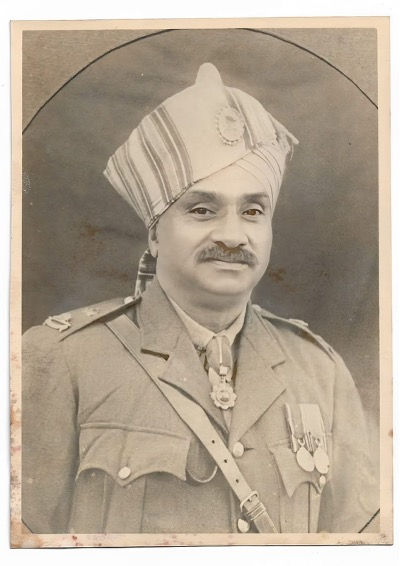
Major Govind Rao Rangnekar, Bahadur, OBI Commandant, Gwalior Imperial Service Transport Corps
- Pruthvi Rangnekar
- Jan 18
- 14 min read
And thus the sons of Hindustan, from Himalaya to Scinde,
From Hindu Kush to Deccan plains,
Rent in a day the ancient chains
Which isolated class from clan,
And joined the battle as one man,
To die for Mata Hind.
For India’s sons had sealed their oath, according to their laws;
Sealed it with blood across the sea,
From Flanders to Gallipoli,
On Tigris’ banks, on Egypt’s sands,
‘Mid Africa’s swamps and hinterlands,
And died in England’s cause.
An excerpt from the poem Hurnam Singh published in With the Indians in France by General Sir James Willcocks, GCMB, KCB, KCSI, DSO
Major Govind Rao Rangnekar, Bahadur, OBI belonged to the Rangnekar family who hailed from the village of Sawantwadi located in the Konkan region of Maharashtra. During the rule of the Marathas, his ancestors were supposedly the ‘Killedars’ or commanders of the Rangna fort which is situated in the Kolhapur district of present-day Maharashtra; hence the family had adopted the surname ‘Rangnekar’ (the original surname being Rajadhyaksha). There are references that a member of the Rangnekar family by the name of Raghoram was a part of the Maratha cavalry during the famed campaign of Raghunath Rao Peshwa in 1758 when the Maratha forces reached the Indus river and the Attock fort. He was a brave warrior and was supposedly present in the siege of Nagaur, Kunjapura and various other battles (Kudva, 1972; Nayak, 1962; Rajadhyaksha, 1907). A number of Rangnekars also served in various positions in the princely state of Sawantwadi (Pingulkar, 1911). As a result of such a background, martial tradition was always present in the family.

Govind Rao’s father Dattatraya Raghunath Rangnekar moved to Gwalior in the last quarter of the 19th century. As a result, Govind Rao and his younger brother Sadanand Rao joined the Gwalior State Forces. A number of units of the Gwalior State Forces were a part of the Imperial Service Troops and as a result took part in various campaigns.
Imperial Service Troops
The Imperial Service Troops were recruited, trained and equipped by the Indian Princes at their own cost. The objective was to train, organise and equip the units to the standards of the Indian Army and the units were supposed to be capable of taking part in campaigns alongside the Indian and British armies.
The contingent forces of various States had been disbanded following the Revolt of 1857, the States no longer contributed to the defence of the Empire. But this changed in the 1880s when after the end of the Second Afghan War, Britain became alarmed because of the Russian advance and occupation of Merv close to the Afghan border in February, 1884. The Russians seized Panjdeh on 31st March, 1885. The Afghans retreated to Herat and the Government of India was instructed to mobilise an army in case of a Russian attack. The Russians withdrew from Panjdeh, but this event laid the ground of an idea of utilising the military resources of the rulers of various States. In 1885, sensing that the war was on the horizon, the Nizam of Hyderabad offered a large sum to the war chest which was followed by various other rulers, but the government felt that the purpose would be better served if various rulers maintain troops required for defence. Colonel George Chesney propagated the idea and in 1887 Major Mellis of Bombay Staff Corps was selected to visit the States and study the actual condition and probable future capabilities of their armies. A committee consisting of Sir Frederick Roberts C-in-C, George Chesney (principal architect of the scheme) the Foreign Secretary, Sir Mortimer Durand, and Sir James Lyall was formed to consider various proposal submitted by the rulers. Lord Dufferin set out his proposals at a durbar held on 17 November, 1888. The scheme was accepted by the rulers and the detailed units became known as Imperial Service Troops (IST). By 1889 the movement had made a start with regiments of cavalry, battalions of infantry, companies of sappers, the Camel Corps of Bikaner, and units of mule and pony draught transport being formed (Head and McClenaghan, 2013).
Since, the Imperial Service Troops were supposed to be trained and equipped to the standards of the Indian Army, the levels of training and equipment were to be monitored regularly and experienced officers of the Indian Army were made available for this role. These officers usually holding the rank of Major or Captain were designated initially as Inspecting Officers and Assistant Inspecting Officers, who were seconded for fixed tours and were usually experts in their arm of service. The States were grouped into Inspection Circles with an Inspecting Officer and an Assistant Inspecting Officer presiding over each circle and visiting each State (Head and McClenaghan, 2013).
The Imperial Service Troops were maintained at the expense of their respective rulers. As a testimony to their standard of training, Lieutenant General Sir Stanley Maude KCB, C-in-C Mesopotamian Expeditionary Force wrote in 1917,
“A very high standard of efficiency, too, has been reached by the Imperial Service Troops serving with this Army. The excellent spirit, zeal and keenness that has permeated them has proved a valuable asset, and our thanks are due to the ruling Chiefs of India by whose generosity and patriotism these Units have been provided and kept in the field.” (Head and McClenaghan, 2013).
During World War I, close to 22,000 troops of various States were a part of Imperial Service Troops out of which around 18,000 served overseas and several units distinguished themselves.
India and The First World War
The First World War or the Great War as it was known then was fought from 1914 to 1919. While the immediate cause of the war was the assassination of Archduke Franz Ferdinand the heir to the throne of the Austro-Hungarian empire, and his wife Duchess Sophie by a member of ‘The Black Hand’ named Gavrillo Princep, a nineteen-year-old Bosnian Serb (Singh, 2014), but Europe had been sitting on a tinderbox since decades because of the numerous treaties between various European powers that were mostly militaristic in nature and a number of events (railway concessions in Turkey, Russo-Japanese War and the Boer War) caused friction between various European powers (Hart, 1934). In the words of Captain B.H. Liddell Hart, ‘Fifty years were spent in the process of making Europe explosive. Five days were enough to detonate it’.
On 28th July, Austria declared war on Serbia. On 1st August, Germany declared war on Russia. On 2nd August, France and Germany ordered general mobilization and at 1400 hours on 3rd August, Germany declared war on France. Great Britain declared war on Germany on the midnight of 4th – 5th August. Germany declared war on Belgium on 4th August and captured Brussels on the 20th. The British Expeditionary Force or BEF comprising of one cavalry and four infantry divisions under General Sir John French landed at the ports of Le Havre, Boulogne and Roune between 15th and 22nd August. By 22nd August, it had deployed forces on the Mons-Conde canal. At its peak deployment, Britain would send fifty divisions to France and a total of 2 million men would take active part in the war. These formations were in addition to those sent by India and the Dominions. During the war, Britain would recruit 5.4 million men for its three services (Singh, 2014).
The Indians had previously fought overseas for the British during the first two Anglo-Afghan wars, the Opium Wars, Boer War and the Boxer rebellion. The China wars, Africa wars and the operations on the Afghan front against the Zakha Khel and Mohmand tribes were mostly brigade level deployments. But during World War I, India raised 1,440,037 volunteers and sent seven Expeditionary Forces to various theatres (Singh, 2014). In fact, the Indian Army was the Allies’ most widespread army of 1914-18, serving in foreign lands across Africa, Asia and Europe that today number some fifty different countries (Morton-Jack, 2018). They were the first to reach France after the deployment of the BEF and took off much pressure from them. By the time the war ended in November, 1918 India had sent 1,302,394 soldiers overseas, out of which 6,75,000 went to Mesopotamia and 1,44,000 to Egypt. In contrast, Australia mobilised 332,000 men and New Zealand mobilized 112,000 men which formed the famous Australian and New Zealand Army Corps (ANZACs), Canada mobilised 458,000 men, South Africa mobilised 136,000 men and America sent 1.3 million men (Singh, 2014).
The Indian Corps in France at the first and second battles of Ypres, Festubert and Neuve Chapelle fought for over a year (Singh, 2014). These troops had been trained and equipped for a colonial war. Post their arrival in Europe they were issued a new rifle (Omissi, 1999) and it took some time for the Indian troops to get adjusted to the new rifles, considering the fact that they had no time to exercise or train with the new equipment. As David Omissi writes,
“these underequipped troops were fed piecemeal into the front line in an attempt to stem the German rush between Ypres and La Bassee.”
The British Expeditionary Force was on the verge of being overrun by the German onslaught. The arrival of the Indian Corps in France saved the day for the British. The former Indian Viceroy Lord Curzon said in 1917,
“The Indian Expeditionary Force arrived in the nick of time, that it helped to save the cause of both the Allies and of civilisation, after the sanguinary tumult of the opening weeks of the War has been openly acknowledged by the highest in the land, from the Sovereign downwards” (Morton-Jack, 2018).
The Indians fought despite shortages in medical supplies and signalling apparatus. The Germans had trench mortars, searchlights and hand grenades, whereas the Indians lacked all of these, though they had managed to make improvised grenades using jam tins! (Omissi, 1999).
Indian cavalry units like the Poona Horse, Hodson’s Horse, 2nd Lancers, Skinners Horse, Jodhpur Lancers and others too acquitted themselves with distinction across the plains of Europe. By the end of the war, the Indian Army had lost 74,000 men and the Indian soldiers had won eleven Victoria Crosses and ninety-nine Military Crosses (Subramaniam, 2016).
A number of units of various state forces were deployed during the First World War including the Gwalior Imperial Service Transport Corps.
The Gwalior Imperial Service Transport Corps and
Major Govind Rao
Major Govind Rao Rangnekar was commissioned on 21st February, 1907 into the ‘A’ Battery, Scindia’s Horse Artillery of the Gwalior State Forces. The ‘A’ Battery was raised in 1854 as ‘Horse Artillery’ and became the ‘A’ Battery, Scindia’s Horse Artillery in 1908. It was equipped with 9-pounder muzzle loading guns.
Govind Rao was transferred to the Gwalior Imperial Service Transport Corps on 23rd October, 1914 as Captain and Commanding Officer and he commanded it till his demise in 1922. When the First World War broke out, he was appointed as the Commandant of the Gwalior Imperial Service Transport Corps. He remained the Commandant of the Gwalior Transport Corps throughout the duration of the First World War and the Third Afghan War.
At the outbreak of World War I, the 1st Jayaji Lancers, 2ndAlijah Lancers, 3rdMaharaja Madho Rao Scindia’s Own Lancers, 3rd Maharaja Scindia’s Own Infantry, 4th Maharaja Bahadur Infantry and the Gwalior Transport Corps were a part of the Imperial Service Troops. They served on active operations in France, Egypt, East Africa, Salonika, Mesopotamia, Palestine, Waziristan; on garrison duty in Bannu, Quetta and Rawalpindi and on the training of Imperial Remounts in Aurangabad, Deolali and Gwalior.
The Gwalior Imperial Service Transport Corps was raised at Morar in 1890 and the unit’s first operational deployment was in Chitral in 1895, when it joined the Chitral Relief Force of Chitral Expedition at Nowshera. The unit was awarded the Battle Honour ‘CHITRAL’(Head and McClenaghan, 2013).
During the First World War, the Gwalior Imperial Service Transport Corps was divided into various detachments that were sent to France, Gallipoli, Salonika and a large contingent went to Mesopotamia. The detachment sent to France, comprising of 107 Officers and Men, 198 ponies, 68 tongas and 12 A.T. carts arrived in Marseilles by 10 November, 1914 and proceeded to the front. The Corps was present in the famed battles of Festubert, Neuve Chapelle, La Conture, La Bassee, Bethune and Ypres. In June 1915, another detachment comprising of 53 other ranks was attached to the Indore Transport Corps who were sent to Gallipoli and then to Salonica (Head and McClenaghan, 2013).
A contingent of the Corps from Marseilles was also sent to Mesopotamia and they arrived in Basra towards the end of 1915. The Gwalior Transport Corps was employed in detachments, one of which was attached to 2nd Queen’s Own Sappers and Miners and was present at the battles of Kut, Baghdad, Ramadi, Khan Baghdadi, Tekrit, while another was attached to the 6th Cavalry Brigade and was present at Kikrut and Mosul, whereas another detachment was employed at Baghdad on convoy duties at the advance supply depot and later proceeded to Babylon. The Corps was in Mesopotamia for three and half years, after which it returned to India (Head and McClenaghan, 2013).
Major Govind Rao was part of the contingent that went to Mesopotamia. The then commanding officer of the Gwalior Service Transport Corps was Lt. Col. Eknath Hathi, CIE who was accused of alleged financial irregularities and as a result Major (then Captain) Rangnekar was sent from Gwalior to take over the charge of all account papers of the Corps and personal account of Lt. Col. Hathi. The Field Treasury authorities were instructed to make advances to Capt. Rangnekar on his requisition and not to Col. Hathi. Col. Hathi was stripped of his CIE and his name erased from the register of the order (Foreign and Political Department, 1921; Gazette of India, 1921).
Govind Rao had arrived with a large detachment which was posted at Baghdad. In May 1918, he proceeded with Corps to Hilla which located around 100 kilometers from Baghdad on the banks of the Euphrates. During this assignment, he worked in the rationing of detachments and outlying political posts. He was thanked by the Assistant Director of Local Resources and by the Officer-in-charge of Supplies Hilla area for his valuable assistance in collection of the Hilla harvest. He was promoted as a Major on 8th November, 1918 towards the end of the war.The condition of the Gwalior Transport Corps under his command was highly praised tenure by the Inspector General of Transport at General Head Quarters. Major C. D. May, Special Service Officer, Gwalior Imperial Service Transport Corps in his report submitted to the Inspecting Officer, Central India Imperial Service Cavalry & Transport writes,
“I attribute the very small incidence of disease among the men and low wastage among the animals to his excellent interior economy and bandobust and to the keen interest he takes in the welfare of men and animals. The Corps under his command has done the same work with ponies that two Corps have done which were horsed with highly selected mules and he has kept it at all times in a high state of efficiency.”
Upon the return to India, the Gwalior Transport Corps was immediately despatched to Meerut and after refitting and reorganisation, the unit was posted to Peshawar and the Khyber during the Third Afghan War. Major Govind Rao served in the North West Frontier in 1919. The Corps finally returned to Gwalior after having spent over five years away from home.
At the end of the First World War, the Gwalior Transport Corps had more experience of foreign service than the other regiments of the Gwalior State Forces. During the Second World War, the unit was posted on the North West Frontier at Nowshera and Landi Kotal. Later on, it was posted to Burma where it was a part of the 17th Indian Division. It returned to Gwalior in 1946. In 1951, the unit was absorbed into the Indian Army as 10th Animal Transport Company (Head and McClenaghan, 2013). Through the course of its history, the unit was awarded the Battle Honours- CHITRAL, PUNJAB FRONTIER, TIRAH, MESOPOTAMIA 1918 and AFGHANISTAN 1919.
For his services, Major Govind Rao Rangnekar was awarded the Order of British India -2nd Class- with the title of ‘Bahadur’ (notification no. 694 dated 17th April, 1920), the British War Medal, the Allied Victory Medal- for the First World War, the Delhi Coronation Medal 1911 (18th April, 1912), the India General Service Medal with the clasp Afghanistan NWF 1919.
Major Govind Rao Rangnekar, Bahadur, OBI passed away sometime in 1922, but we are not aware of his exact age at the time of his passing, nor the cause of his death (whether it was due to natural causes or any ailments).
Personal Life and Family
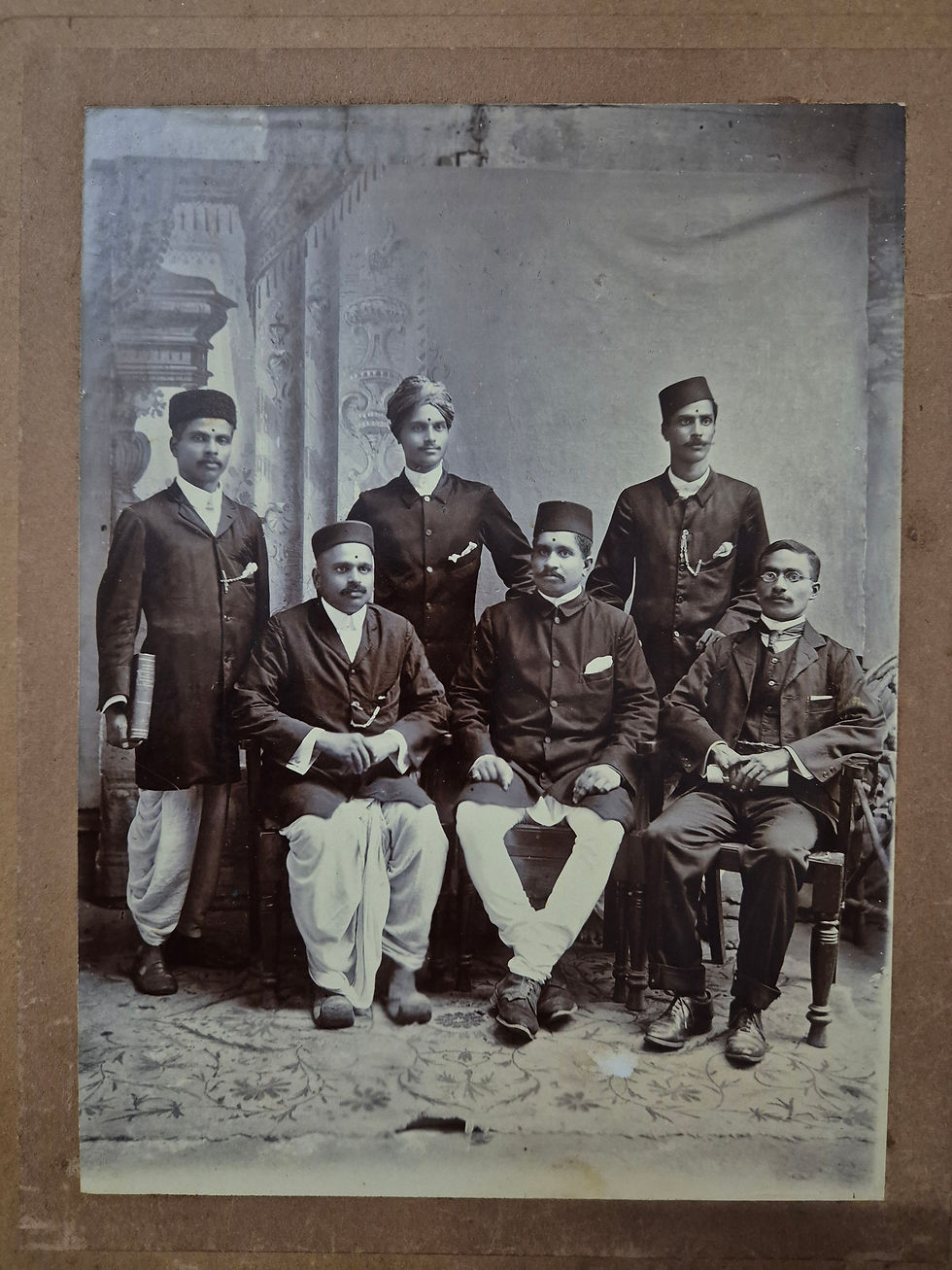
Major Govind Rao’s father Dattatraya Raghunath Rangnekar (also spelt Dattaram in some letters) moved from Sawantwadi to Mumbai and later on to Gwalior around the 1880s. Dattatraya Raghunath Rangnekar had two sons Govind and Sadanand. Govind Rao was the eldest son and Sadanand Rao was his younger son. Govind Rao was a religious person and never missed his daily prayers even when deployed. Therefore, he was fondly referred to as “Bhua” or a holy man by those under his command. One of the soldiers who had served with Govind Rao was a riding instructor in the Mhow Veterinary College where Major Govind Rao’s grandson Dr. D. V. Rangnekar did his graduation and the riding instructor used to always tell young Dattatreya that being a Rangnekar he should not be scared or apprehensive while learning to ride a horse as Major Govind Rao was an accomplished rider and would frequently ride a horse without a saddle! (narrated by Major Govind Rao’s grandson and the author’s maternal grandfather Dr. Dattatreya V. Rangnekar).

As mentioned earlier Major Govind Rao’s younger brother was Major Sadanand Rao Rangnekar, Sardar Bahadur, OBI. Sadanand Rao was commissioned into the 6th Field Artillery of Gwalior State Forces on 27th October, 1911. He was transferred to the ‘B’ Battery, Scindia’s Horse Artillery on 19th November, 1917. The ‘B’ Battery was raised as 3rd Company Artillery at Lashkar and became the ‘B’ Battery, Scindia’s Horse Artillery in 1908. In 1911, the unit was equipped with 9-pounder horse-drawn guns.
Sadanand Rao commanded the 1st Gwalior Mountain Battery from 1927 till his retirement in 1940. He was awarded the Order of British India Second Class with the title of ‘Bahadur’ w.e.f. 3rd June, 1935 and was promoted to the Order of British India First Class with the title of ‘Sardar Bahadur’ w.e.f. 14th January, 1940. He retired from service in 1940. After independence, the Gwalior Mountain Battery saw action in the first Indo- Pak war in 1948 and later on was absorbed into the Indian Army becoming the 74th (Gwalior) Mountain Battery, Indian Army.
Major Govind Rao had three sons Vitthal, Ramakant and Chandrakant. The eldest Capt. (Dr.) Vitthal Rangnekar was awarded a scholarship by the Gwalior Durbar and went on to complete his MBBS from Grant Medical College, Mumbai in 1932. He was in the service of the Gwalior State and during World War II he was commissioned as a Lieutenant and later was promoted to Captain and was attached to the 3rd Gwalior Lancers (Maharaja Madhav Rao’s Own) for the duration of World War II. After the end of World War II, he resumed his civil duties as a civil surgeon.


Acknowledgements
The author wishes to thank his grandfather Dr. D. V. Rangnekar for telling some of the tales of the latter’s grandfather Major Govind Rao, as well as for passing down the photographs; Mr. Sunil Rangnekar for providing the photograph of Major Sadanand Rao; Brig. A. S. Adhikari, VSM (Retd.) for his guidance and Commodore Srikant Kesnur, VSM (Retd) for his guidance and suggestions over the years and for publishing the article; Sqn. Ldr. Rana T.S. Chhina, MBE (Retd) for the prompt response to the author’s email seeking information about various ancestors; Brig. M. S. Jodha (Retd) author of The Story of the Jodhpur Lancers 1885-1952, Mr. R. Prasannan and Adil R Chhina for their suggestions and responses to the author’s questions.
References:
Administration of the Gwalior State during the year 1934-35, Printed at the Alijah Darbar Press, Lashkar, 1937.
Foreign and Political Department, 1920, Internal- B, April 1920, Nos. 115-116
Foreign and Political Department, 1921, Internal- B, September 1921, Nos. 352-354
Gazette of India, 25th June, 1921- London Gazette- 24th May 1921
George Morton – Jack, ‘The Indian Empire at War’, 2018
Head, Richard and McClenaghan Tony, ‘The Maharajas’ Paltans- A History of the Indian State Forces 1888-1948’, United Service Institution of India, 2013.
Kudva, V. N., CIE, ICS, ‘History of the Dakshinatya Saraswats’, Chennai, 1972 (Fifth edition 2010).
Liddel Hart, B. H., ‘A History of the First World War’, Pan Books, 2014.
List of Honors Awarded to the Indian Army August 1914 to August 1921, Central Publication Branch, 1931.
Mohammad Rafiullah, ‘Gwalior’s Part in the War’, 1920.
Nayak, Narayan, ‘Gatkaalin Gomantakiya Mutsaddi’, Goa, 1962.
Omissi, David, ‘Indian Voices of the Great War’, 1999
Pingulkar, Vithal, ‘Sawantwadi Sansthanacha Itihas’, Sawantwadi, 1911.
Rajadhyaksha, N. V., ‘The Life of Bakshi Bahadar Mujafardaul Jiwajee Ballal alias Jivabadada Kerker’, Bombay, 1907.
Singh, Amarinder, ‘Honour and Fidelity’, Roli Books, New Delhi, 2014
Subramaniam, Arjun, ‘India’s Wars- A Military History 1947-1971’, Harper Collins Publishers, 2016.
The Half-Yearly Gwalior Army List, Army Headquarters, Gwalior State, 1920.
Pruthvi Rangnekar
Pruthvi Rangnekar is a museum curator and archaeologist specialising in maritime history. He served as the curator of India's oldest maritime museum, the Marine Museum at Training Ship Rahaman in Nhava, Navi Mumbai. He is currently the Curator (Fort) at the Surat Municipal Corporation.
P.S. While Meluha Maritime is primarily devoted to India’s maritime and naval legacy, we are equally drawn to well-researched biographical narratives that preserve memory, honour lineage, and illuminate the men, women and institutions that shaped our armed forces in earlier eras. Our thanks to the author for preserving and sharing the legacy of Major Govind Rao Rangnekar, Bahadur, OBI.


Comments