


Surat: A city that never stops sailing forward
Updated: Oct 4
Author's Note
My recent visit to Surat was the catalyst for this piece. The last time I was in the city, I had purchased a diamond for my wife—a time when the natural diamond trade was booming, and acquiring a stone directly from the source felt both authentic and reasonable. Returning this time, I found the diamond district unexpectedly quiet, caught in the doldrums of a global market shift. That stark contrast set me thinking about the city's broader story.
Surat and I have an older, more personal connection. Years ago, when my younger brother was studying at SV REC, Surat (now SV NIT), his trips home were always accompanied by exquisite silk sarees for our mother, and boxes of the city's legendary Khari and Nankhatai for the rest of us.
But my deepest connection to the city was forged in uniform. As the Admiral Superintendent of the Naval Dockyard in Mumbai, I walked the same historic grounds where the Wadia master craftsmen—who originally hailed from Surat—had once built legendary vessels like HMS Trincomalee and HMS Minden. Later, during my tenure at Naval Headquarters, we named one of our formidable Project 15B destroyers INS Surat. I remember pondering then why this particular city had been chosen. Looking at the city today, the answer is remarkably clear. It is an acknowledgement of a profound, unyielding resilience. This piece is a reflection on a city that I have come to realise is India's eternal phoenix.
History has a habit of writing obituaries for Surat.
Ports silt up. Industries lose competitiveness. Epidemics strike. Global markets collapse. Yet every time the world assumes Surat has finally faded into the history books, the city quietly reinvents itself.
The story of Surat is not merely about ships, silk or diamonds. It is a masterclass in enterprise, resilience and adaptation. For those of us with salt water in our veins, there is much to admire—and much to learn—from this remarkable city on the banks of the Tapi.
The Gateway and the Master Builders
At its height under the Mughal Empire, Surat was among the richest cities in Asia. Known as Bab-ul-Makkah—the Gateway to Mecca—it served as the principal embarkation point for pilgrims sailing to the Holy Cities and was one of the busiest ports linking India with Arabia, Persia, East Africa and Europe. Merchants from across the world crowded its docks, making it one of the most prosperous trading centres of its age.
Its immense wealth was legendary. Chhatrapati Shivaji Maharaj raided Surat twice, recognising that control of its commerce meant influence over the region's economy. Before Bombay emerged as western India's commercial capital, the English East India Company established its first major headquarters in Surat. But Surat did not merely facilitate trade; it supplied the craftsmen who built the ships that sustained empires.

The celebrated Wadia family of Parsi master shipbuilders hailed from Surat. In 1736, Lovji Nusserwanjee Wadia was invited by the East India Company to establish modern shipbuilding facilities at Bombay, laying the foundations of what is today the Naval Dockyard Mumbai. Over the next century and a half, the Wadias built more than 350 vessels, including some of the finest warships ever constructed outside Britain. HMS Trincomalee and HMS Minden remain enduring symbols of their craftsmanship.

In many ways, Mumbai's naval heritage was built with the tools and talent of Surat.
As maritime trade gradually shifted towards deeper harbours and larger ports, Surat could easily have declined into historical obscurity. Instead, it discovered a new future.
Silk, Synthetics and the Great Diamond Pivot
Surat had been a renowned textile centre for centuries, producing exquisite silks and fine fabrics that travelled across Asia and Europe.
As markets changed, the city adapted once again. Rather than clinging to traditional weaving alone, Surat embraced synthetic textiles - eventually becoming India's largest producer of polyester and man-made fabrics. Today, the city supplies an enormous share of the country's synthetic textile requirements, supporting thousands of entrepreneurs and millions of livelihoods.


Then came another remarkable reinvention.
Entrepreneurs from Surat transformed the city into the world's diamond polishing capital. Rough stones arrived from Africa and Russia, trading networks extended through Antwerp and Mumbai, and generations of highly skilled artisans built an industry that came to process nearly ninety percent of the world's natural diamonds.
The industry's spectacular rise culminated in December 2023 with the inauguration of the Surat Diamond Bourse by Prime Minister Narendra Modi. The vast complex became the world's largest office building, symbolising decades of entrepreneurial success.

Yet history had another lesson in store.
Almost as the Bourse opened its doors, the natural diamond industry entered one of its most difficult phases. Weak global demand, changing consumer preferences and the rapid rise of competitively priced lab-grown diamonds placed enormous pressure on the traditional trade. The irony was striking. A complex built to celebrate the success of natural diamonds opened just as that very industry entered turbulent waters.
But Surat has never viewed disruption as defeat.
Many entrepreneurs who built their fortunes in natural diamonds are now investing in lab grown diamonds, recognising that technology has fundamentally altered the economics of the business. The transition is still unfolding, but the city's response has remained true to character. Rather than resisting change, Surat is embracing another industrial transformation.
From Plague to Pristine
Perhaps the city's greatest test came in September 1994.
An outbreak of pneumonic plague triggered widespread panic and a mass exodus. International headlines portrayed Surat as a city overwhelmed by poor sanitation and urban disorder. For many cities, such an event would have cast a shadow lasting generations.
Instead, it became another turning point.
Under the dynamic leadership of Municipal Commissioner S. R. Rao, Surat embarked upon one of the most remarkable civic transformations seen in modern India. Roads were widened, drainage improved, sanitation revolutionised and civic administration fundamentally reformed.
Within a generation, the city once associated with plague had become one of India's cleanest and best-managed urban centres, consistently featuring among the leaders in the Swachh Survekshan rankings and jointly winning the number one position in 2024. It was another reminder that Surat's greatest strength lay not in any single industry but in the determination of its people and institutions to respond decisively to adversity.

Returning to the Sea
History has an elegant way of coming full circle.
Three centuries after the Wadia master shipbuilders carried Surat's maritime skills to Bombay, strategic manufacturing has once again become one of the city's defining strengths.
The Hazira industrial belt has emerged as one of India's most important centres for heavy engineering and defence production. Larsen & Toubro's AM Naik Heavy Engineering Complex manufactures sophisticated equipment ranging from the Zorawar light tank to critical systems for India's indigenous naval programmes. The company is simultaneously investing in future technologies that will shape India's energy and industrial landscape in the decades ahead.
As India develops its next generation of indigenous submarines and advanced naval platforms, the engineering capability concentrated around Hazira will remain an important national asset.
The symbolism could hardly be more appropriate.
On 15 January 2025, the Indian Navy commissioned INS Surat, one of its newest guided missile destroyers. The city whose craftsmen once helped build the maritime power of an empire now lends its name to the maritime power of an independent India.
For someone who was present when that name was chosen, the continuity feels deeply, personally satisfying.


The Real Competitive Advantage
Looking back over four centuries, one realises that Surat has never depended upon a single industry.
Ships gave way to textiles. Textiles were joined by diamonds. Natural diamonds are now sharing space with lab-grown diamonds. Heavy engineering, defence manufacturing and new technologies are opening yet another chapter.
The industries have changed repeatedly. The entrepreneurial character of the city has not.
Generation after generation, Surat's merchants, craftsmen and industrialists have demonstrated an instinct for recognising change early, adapting quickly and investing boldly in whatever comes next. That culture of enterprise—rather than any individual business—is the city's greatest competitive advantage.
The Constants that endure
Through every rise and fall, some things have remained wonderfully unchanged.
The entrepreneurial spirit of the Surti people continues to define the city. Equally enduring are the simple pleasures that generations have cherished. Long before diamonds brought global recognition, and long after markets have shifted, neighbourhood bakeries have continued serving butter khari and Nankhatai with the same quiet consistency.
Empires have risen and fallen. Industries have flourished and faded. But the khari and the cutting (half cup of chai) have survived them all.

As I left Surat after this visit, I realised that the city's greatest export was never silk, diamonds or even ships.
It was resilience. It was the confidence to reinvent itself without losing the entrepreneurial spirit that had defined it for centuries.
When I first saw the quiet corridors of the Surat Diamond Bourse, I wondered whether Surat's finest days were behind it. By the time I left the city, I realised I had been asking the wrong question. The better question was not whether Surat would recover, but what it would reinvent itself into next.
If one city can repeatedly transform itself over four hundred years, then setbacks are never permanent. They are merely the beginning of the next chapter.
Perhaps that is why the name INS Surat feels so appropriate for a modern warship. To carry the name of Surat is to carry the spirit of a city that refuses to surrender to circumstance - a city that has always found a way to rise again and, true to its maritime heritage, never stops sailing forward.
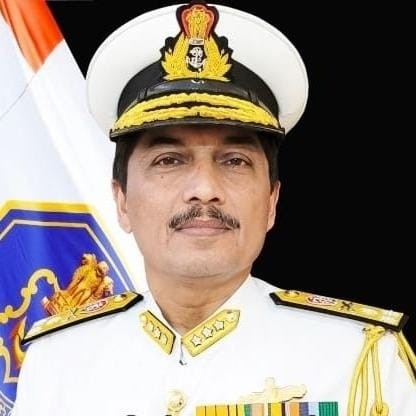
Vice Admiral Sandeep Naithani
Vice Admiral Sandeep Naithani, PVSM, AVSM, VSM last served as the Chief of Materiel, the Indian Navy’s senior most technical officer and Principal Staff Officer responsible for all engineering, electronics, weapons, and IT systems on ships and submarines.
Commissioned into the Electrical Branch on 1 January 1985, he is an alumnus of NDA, IIT Delhi, DSSC and NDC.
Over a 39‑year career, he commanded INS Valsura, served on board INS Viraat, held key dockyard and technical roles in Mumbai and Visakhapatnam, and advanced through appointments such as Admiral Superintendent, Naval Dockyard Mumbai, Director General Naval Projects, and Controller of Warship Production & Acquisition before assuming charge as Chief of Materiel on 1 June 2021 to lead the Navy’s modernisation, indigenisation, and infrastructure development.
Disclaimer: The views and opinions expressed in this article are those of the author.


Thank you for a detailed legacy of the area.
I guess "wisdom" of the locals irrespective of being educated in schools or not, plays a great role by working in tandem with the govt.
The enlightnent of peoole of the area was highlighted during another sordid episode..the Tata nano story though not of surat per se yet of the geographical area.
Werein the state facilitated a corporate in setting shop and locals captured the opportunity , generating employment, vendorship and thus more employment , when another geopraphical location had its people n govt armtwist that corporate, forcing it to leave.
Thanks once again..For the lovely history
Awesome information
Congratulations
Very informative. Never knew this about Surat. Very well researched and positive feedback about our super city.
You have a good connection with the soul of Surat. You have encapsulated what Surat stands for, and rightly said that for over 3 centuries, this city has always reinvented itself.
As always, thinking positive.