


INS Valsura: Eight Decades of Service, Innovation and Human Connection
Updated: Oct 4
Author's note
Among the many branches of the Indian Navy, Electrical Officers occupy a unique place. Affectionately known as "Sparks," they are responsible for the electrical, electronic, weapon, and combat systems that form the technological backbone of modern warships, submarines, and naval aviation.
For Electrical Officers and Sailors of the Indian Navy, INS Valsura is more than just a training establishment - it is an alma mater. Generations of officers and sailors have passed through its portals, and all proudly carry the identity of being "Valsurians." The institution has shaped careers, forged lifelong friendships, and contributed quietly but significantly to the operational readiness of almost every major platform in the Indian Navy.
Jamnagar itself occupies a unique place in India's military landscape. Few stations can claim to host all three Armed Services in one location, each commanded by a one-star officer. The only other place that comes readily to mind where officers of equivalent rank command all three services is New Delhi, where the Chiefs of the Army, Navy, and Air Force serve together at the apex of their respective organisations.
For many years, Valsura was fondly known as the "Oasis of Saurashtra." Situated in the arid landscape of western Gujarat, it stood out as a lush green haven created through the dedication of successive generations of Valsurians. Today, Jamnagar is equally renowned for another remarkable achievement - the world's largest refining complex established by Reliance Industries, whose extensive green cover has transformed the region and become a matter of pride for the city.
Although I retired from the Indian Navy on 31 December 2023, Valsura remains very close to my heart, as it does to countless Valsurians across generations. We take immense pride in its rich heritage, its tradition of excellence, and its continued evolution as one of the Navy's foremost centres of technological innovation. The story that follows is therefore not merely the history of an establishment. It is the story of an institution that has touched thousands of lives and continues to illuminate the path for future generations.
It is often said that the maritime community is a closely-knit family. Yet, every now and then, history conspires to remind us just how small that family really is.
In March 2026, my wife Manju and I had the pleasure of reuniting with Colonel Robert Ward and his wife Elizabeth in New Delhi during their visit to India. It was a warm and memorable occasion, made even more special because our first meeting had taken place more than a decade earlier, in 2012, when I had the privilege of serving as the Commanding Officer of INS Valsura in Jamnagar.


The Ward family occupies a unique place in the history of INS Valsura. Colonel Robert Ward is the son of Commander M.F.B. Ward, Royal Navy, the first Commanding Officer of HMIS Valsura. Continuing a distinguished tradition of service, Colonel Ward served with distinction in the Royal Marines and was appointed a Member of the Order of the British Empire (MBE) for his outstanding work as a Trustee of Combat Stress, a leading veterans' mental health charity in the United Kingdom.
The family's maritime legacy continues through their daughter Emma, an accomplished sailor who has participated in transoceanic races and global sailing expeditions. Her passion for the sea resonates strongly with recent achievements closer to home. In a magnificent display of Nari Shakti, Lieutenant Commander Dilna K and Lieutenant Commander Roopa A of the Indian Navy recently completed the Navika Sagar Parikrama II global circumnavigation aboard INSV Tarini in the demanding double-handed mode. Adding another remarkable connection, Emma's husband, Major Richard Kettle, serves as an International Liaison Officer at the Information Fusion Centre – Indian Ocean Region (IFC-IOR) in Gurugram. It truly is a small maritime world.
Yet the story stretches much further back.
The origins of INS Valsura lie in one of the most dramatic periods of the twentieth century. August 1942 was a month marked by turmoil across the globe. While World War II raged across continents, India was in the midst of the Quit India Movement. Against this backdrop, a young Royal Navy officer named Commander M.F.B. Ward arrived in India with orders to establish a new torpedo training school for the Royal Indian Navy.
Commander Ward was no stranger to adversity. In September 1939, he had survived the sinking of HMS Royal Oak at Scapa Flow, one of the Royal Navy's most shocking early wartime losses. Barely three years later, he embarked on a journey of more than 12,500 miles through wartime Europe, Africa, and the Middle East before reaching India. His meticulously maintained diaries, later compiled by his son under the title Journey to Valsura: 1942–1946, provide a fascinating account of those extraordinary years.

The foundation stone of HMIS Valsura was laid on 15 August 1942 - a date that would, five years later, become immortalised in Indian history. What followed was nothing short of remarkable. Under Commander Ward's leadership, the establishment was constructed and commissioned in just four months. On 15 December 1942, HMIS Valsura formally came into existence as the Torpedo School of the Royal Indian Navy.
A central figure in this achievement was His Highness Maharaja Digvijaysinhji, the Jam Saheb of Nawanagar. Statesman, soldier, sportsman, and humanitarian, he was a steadfast supporter of Valsura throughout his life. Commander Ward's diaries record a simple but telling observation:
"The Jam Sahib made it possible in the first place."
The Jam Saheb's generosity extended far beyond India. During World War II, he provided refuge and care to hundreds of Polish children displaced by the conflict. His compassion earned him enduring gratitude in Poland, where memorials and public commemorations continue to honour his memory to this day.

The friendship between Commander Ward and the Jam Saheb went well beyond official responsibilities. The diaries recount rounds of golf, tennis, riding, and numerous social interactions shared between the naval officer and the royal family. In a touching testament to this relationship, when Robert Ward was born on 15 June 1945, the Jam Saheb personally wrote to Commander Ward to congratulate him on the birth of his "son and heir."
Reading Commander Ward's diaries today, one is struck by how the values that shaped Valsura in 1942—service, innovation, leadership, excellence, and compassion—continue to guide the establishment more than eight decades later.
Over the years, generations of Electrical Officers, Sailors, Artificers, and Technicians have passed through Valsura's portals. The establishment has quietly contributed to the combat readiness of virtually every major warship, submarine, and naval aviation platform inducted into the Indian Navy. Few training institutions can claim such a sustained and enduring impact on national maritime capability.
Today, INS Valsura remains the Indian Navy's premier training establishment for advanced electrical, electronic, weapon, and combat systems. From its origins as a wartime torpedo school, it has evolved into one of the Navy's foremost centres of technological excellence. In recent years, it has emerged as a leading hub for work in Artificial Intelligence and is actively exploring frontier technologies, including Quantum Computing.
Yet, Valsura's legacy is defined as much by its humanitarian heart as by its technological prowess.
When the devastating Gujarat earthquake struck in January 2001, the nearby village of Moda, located about 40 kilometres from Valsura, was almost completely destroyed. In response, INS Valsura undertook a remarkable mission that went far beyond conventional military responsibilities. Through Project Nai Roshni, the Indian Navy adopted the village, relocated the affected community, and rebuilt it as "Navy Moda."

What made the initiative particularly inspiring was that it was funded entirely through the contribution of one day's pay by every officer and sailor of the Indian Navy. Under the leadership of Commodore T. S. Ganeshan - who later rose to the rank of Rear Admiral and subsequently served as Chairman and Managing Director of Garden Reach Shipbuilders & Engineers - a dedicated team comprising myself, Commander S. Satish, and Lieutenant Commander Mohan Lal worked closely with the villagers to rebuild their community. The reconstruction incorporated earthquake-resistant designs developed in collaboration with the Centre of Science for Villages, Wardha.
The project became a shining example of the Navy's commitment to national service beyond the seas. More importantly, it demonstrated how an institution built to defend the nation could also help restore hope, dignity, and livelihoods to fellow citizens in their hour of greatest need. The story of Navy Moda deserves a separate telling and remains one of the most meaningful chapters in Valsura's history.

The establishment that Commander Ward built in four astonishing months continues to flourish. In March 1944, Vice Admiral John Henry Godfrey, then Flag Officer Commanding the Royal Indian Navy, reportedly described Valsura as the "best and cleanest establishment in the Royal Indian Navy." Successive generations of Valsurians have worked tirelessly to uphold that reputation.
Today, more than eight decades after its foundation stone was laid, INS Valsura continues to evolve while remaining true to its roots.
Its motto, Tasya Bhasa Sarvam Idam Vibhati—"The light that emanates from here illuminates all"—captures this journey perfectly. From the wartime vision of Commander M.F.B. Ward and the unwavering support of the Jam Saheb of Nawanagar, to the humanitarian efforts of Project Nai Roshni, and from torpedo training to Artificial Intelligence and Quantum technologies, Valsura has consistently stood at the intersection of service, innovation, and human connection.
For me, meeting the Ward family again after more than a decade was more than a pleasant reunion. It was a reminder that institutions are ultimately built by people, sustained by relationships, and strengthened by shared values across generations.
From Scapa Flow to Jamnagar, from wartime torpedoes to quantum frontiers, and from Commander Ward to future generations of Valsurians, the story of INS Valsura continues to be written.
And after more than eight decades, the light that emanates from Valsura still illuminates all.
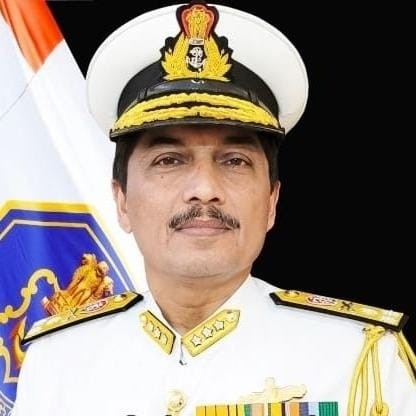
Vice Admiral Sandeep Naithani
Vice Admiral Sandeep Naithani, PVSM, AVSM, VSM last served as the Chief of Materiel, the Indian Navy’s senior most technical officer and Principal Staff Officer responsible for all engineering, electronics, weapons, and IT systems on ships and submarines.
Commissioned into the Electrical Branch on 1 January 1985, he is an alumnus of NDA, IIT Delhi, DSSC and NDC.
Over a 39‑year career, he commanded INS Valsura, served on board INS Viraat, held key dockyard and technical roles in Mumbai and Visakhapatnam, and advanced through appointments such as Admiral Superintendent, Naval Dockyard Mumbai, Director General Naval Projects, and Controller of Warship Production & Acquisition before assuming charge as Chief of Materiel on 1 June 2021 to lead the Navy’s modernisation, indigenisation, and infrastructure development.
Disclaimer: The views and opinions expressed in this article are those of the author.


Jai Hind Sir
I genuinely appreciate how incredible you are, learning from your dedicated efforts in making this Wonderful piece of History which we all Valsurians have learnt today.
Capt MK Sharma
Proud to be a Valsurian. Nice article.
Great to know about our mother establishment
Jai Hind & Hail to the great Indian Navy
Excellent article
Beautifully written, Sir. A deeply insightful tribute to the glorious legacy of INS Valsura—an institution that has shaped generations of “Valsurians” and quietly powered the technological backbone of the Indian Navy.
Particularly inspiring was the blend of history, innovation, and humanity—from Commander Ward’s vision to Project Nai Roshni and today’s AI and quantum initiatives.
Proud to have a connection with an institution whose light continues to illuminate so many lives. ⚓