


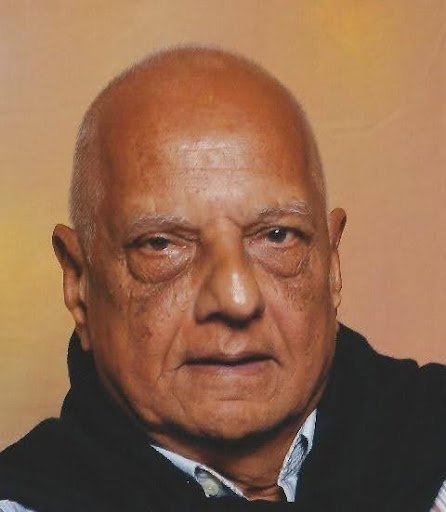
Vice Admiral Daya Shankar, PVSM, DSC (1912–1993)
Updated: Oct 4
Training as a Cadet in Newcastle
Meluha Note
This week's Maritime Musings revisits the formative years of Vice Admiral Daya Shankar, PVSM, DSC, tracing his training as a cadet in Newcastle. More than a personal story, it offers a fascinating glimpse into the traditions, institutions and professional education that shaped a generation of officers who would later lay the foundations of the Indian Navy. This article is written by his son Nitin Shankar.
Vice Admiral Daya Shankar, PVSM, DSC (1912–1993), was one of the pioneering Indian officers of the Royal Indian Marine and a trailblazer in the Indian Navy's engineering branch. Awarded the Distinguished Service Cross (DSC) for gallantry during the Second World War, he went on to become the first engineering officer to attain flag rank, the first Indian Chief of Materiel, and the first officer from the Indian Armed Forces to serve as Controller General of Defence Production. His distinguished career helped shape the technical foundations of the modern Indian Navy.

March 1930, Prologue
Daya Shankar had just completed one year of college in Allahabad when he stood for an all-India competitive examination for recruitment of officer cadets for the Royal Indian Marine in 1929.
When the results were announced, Daya Shankar had topped the list. He opted for the engineering branch of the navy, as his father was also an engineer. The training included a five-year apprenticeship with a shipbuilder as well as attending night classes. His grandfather came up with the sum of Rupees 7,500 as part payment for the training – a large amount for those days.
On 13 March 1930, Daya Shankar, aged eighteen, left on the P & O ship Narkunda for Tilbury. He shared a first-class cabin with another naval cadet and, having received a kitting allowance, donned a dinner jacket for the first time for supper. It was a new world where officer cadets were obliged to follow a strict protocol.
Daya Shankar found the voyage instructive. He got to know other passengers, mainly British families returning for home leave. He got familiar with the protocol for multi-course meals. He went ashore on stops in Aden and Port Suez. By the time the ship docked at Tilbury, he had managed the transition from East to West.
On arrival at the port of Tilbury near London, Mr Gastor, an official from the India Office, met Daya Shankar.
Mr Gastor told Daya Shankar and the other naval cadet that the firms were yet to be selected, and that their training would start in early April. He gave them some money and told them to stay within reach. Daya Shankar found a hostel on Cromwell Road in Kensington.
After Agra and Allahabad, London was a heady experience. Daya Shankar spent the first week exploring the city, seeing two plays, a few films and going for walks in Hyde Park.
When his money ran out, Daya Shankar took a job working as an errand boy for Sims, a local pharmacy. He had to be up early in the morning to do chores such as sweeping, dusting and polishing. There were clients who needed home deliveries and cycling around in Kensington was easy. Looking back, Daya Shankar found his work with Sims to be interesting. There were also invitations from clients who were kind and hospitable to him.
Finally, after a few weeks in London, Daya Shankar was summoned to the India Office. Mr Gastor informed him that he had been assigned to join Messrs R & W Hawthorn Leslie & Company in Newcastle as a premium apprentice. He would report to Mr Routledge, the Apprentice Supervisor, who would arrange for his monthly stipend of £20 as well as suitable accommodation.
In April 1930, Daya Shankar left for Newcastle and was met at the railway station by Mr Routledge who took him to his lodgings in Hotspur Street. Mr Routledge introduced Daya Shankar to his landlady, Mrs Emily Horne. She was a widow who had a room for rent. For both, it was a fortunate happenstance. Daya Shankar would stay with Mrs Horne as a paying guest for five years.
April 1930, Newcastle
Daya Shankar started his apprenticeship at St Peters plant, which built large diesel engines and turbines. The St Peters plant was only a fifteen-minute walk away from Hotspur Street. Hawthorn Leslie (as it was known) had two other plants in Newcastle: a locomotive works in town and a shipyard across the river in Hebburn.
On an April morning, Daya Shankar, fitted with overalls, walked to the St Peters plant. He met with Mr Thew, the Director-in-Charge, who told him that he would lunch in the Board Room as he was a premium apprentice. On the shop floor there would be no special privileges. Mr Thew hoped that Daya Shankar would work hard and benefit from the experience.
Daya Shankar was first assigned to the machine shop. He found his foreman, Mr Dodds, to be a strict disciplinarian, but a fair man. His first job was on a lathe, turning ferrules for condenser tubes. As he got more skilled, the jobs became more complex. The experience left him with a lasting love for machine tools of all types. Later, when we worked together, he was forever reading machine tool catalogues and delighted in designing production transfer lines for machining parts.
The workdays at St Peters were long. Daya Shankar worked from 7:30 a.m. to 5 p.m. with a half hour break for lunch. After high tea at home, he attended night classes from 7 p.m. to 9 p.m. Saturdays were half days, spent in writing letters and doing homework.
Daya Shankar considered himself lucky to work with St Peters since the plant produced marine steam turbines as well as diesel engines. The experience gained served him well. Later, as an engineer officer, he served on warships powered by engines made at the St Peters plant.

The St Peters plant owed its origins to an ingenious Geordie who, in his way, contributed to Britain’s industrial revolution by pioneering in steam locomotives and iron ships.
Robert Hawthorn, aged 21, started repairing colliery machinery in 1817. With his brother, William, and four workmen, his enterprise prospered under the trading name of R & W Hawthorn. The company built its first marine engine in 1820 and its first locomotive in 1831. Robert Hawthorn died in 1866; William Hawthorn retired in 1870. By this time, the firm had built over 1,000 locomotives and 100 marine engines. The firm was sold for £60,000 to four men, including William Hawthorn Junior. In the same year, the firm acquired a shipyard from T & W Smith at St Peters. Very soon, all marine engineering work was moved to this site.
It was about this time that the St Peters factory produced a 436 HP steam engine for HMS Shearwater, a wooden sloop. This would be the start of a long relationship with the British Admiralty, providing the impetus for a later move into shipbuilding.
1932 to 1935, Newcastle
The shipping recession hit North East England in 1932.
This led to shortage of work and consequent paring down of workers. Fortunately, Hawthorne Lawrie was less affected because of orders from the Royal Navy and other navies.
Nevertheless, the result was that the apprentices now got work normally given to senior workers. It was hard luck for the workers, but good for Daya Shankar. He improved his skills on a variety of machines. Finally, the company resorted to a four-day week in an effort to retain the more skilled staff.
The diesel shop was worst hit, because it catered essentially to merchant ships. Daya Shankar moved from the machine shop to the diesel shop, and then to the turbine shop.
In mid-1932, Daya Shankar was transferred to the main drawing office. There he worked for a year. During which period he prepared drawings for an Indian sloop under construction. It would later be commissioned as HMIS Indus.
Night school was not a problem. Having completed the first-year course at Allahabad in Physics (Honours), the only two new subjects were Naval Architecture and Engineering. Daya Shankar devoted more time to these subjects and managed a distinction in each subject, earning the Sir Arthur Coote prize for two years running.
The summer of 1933 was an unforgettable one for Daya Shankar.
He worked for a couple of weeks at the drawing office in the St Peters factory and was asked to move to the shipyard in Hebburn where the HMIS Indus, a sloop for the Royal Indian Navy was nearing completion.
Like R&W Hawthorne, the Hebburn shipyard had a heritage going back to the industrial revolution. Andrew Leslie, Shetland-born and with shipbuilding experience in Aberdeen, acquired eight acres of land on the South bank of the River Tyne, about three miles downstream from St Peters. He laid out his shipyard in 1853, reclaiming river frontage by using ballast from the Hebburn Hill. A dry dock was constructed and, by 1885, the firm had launched 255 ships. As sole proprietor of A. Leslie & Company, he laid the foundations of a well-run shipbuilding enterprise. After Leslie’s retirement, his son-in-law, Arthur Coote, arranged for the merger with Hawthorn in 1886.
The new company, R. & W. Hawthorn Leslie & Company Limited, represented a move towards vertical integration. Ships built at the Hebburn yard were usually powered by marine engines made at the St Peters factory.
When Daya Shankar moved to the Hebburn yard, Hawthorn Leslie had a full order book: two merchant ships and six warships (three Royal Navy destroyers, two sloops for the Portuguese Navy and a sloop for the Indian Navy). At other times, the shipyard also made passenger ships, oil tankers and Great Lake steamers.
Daya Shankar enjoyed working in Hebburn although the travel time was longer. He had to catch a local train to Hebburn and take a ferry across the river to get in before 7.30 a.m.; the return journey also took longer. This cut down the time to change, eat and go to night school.
He decided to change his daily routine. Postponing his high tea until after his return from school, he requested Mrs Horne not to wait up as he would manage on his own.
Another problem was that the Hebburn shipyard had no Board Room. He now had to carry his own lunch. Mrs Horne, on her own, started giving him a lunch packet, refusing any increase in the weekly rent.
Daya Shankar found the Tynesiders to be a friendly lot, always willing to help newcomers. Yet, he was sometimes given jobs that taxed his physical limits. He was asked to cut oil grooves in a cylinder liner out in the open. Cooped in the cylinder in the freezing cold, the chisel seemed to burn in his hands. The gloves he wore seemed to have no effect. A fellow apprentice from St Peters offered to take over, but he was much too fat to be able to squeeze in. This was the reason probably why Daya Shankar was chosen.
The years at the Hebburn shipyard influenced Daya Shankar’s future professional ambitions. Interested in shipbuilding, he served as a director on the board of Hindustan Shipyard. After retirement, he got a contract as a consultant to the same shipyard. The practical experience gained at Hebburn had served him well.
Coming to the final year of his apprenticeship, Daya Shankar worked under a senior engineer in carrying out acceptance trials for completed ships.
When a ship neared completion, the usual practice was for the Yard staff to begin stationary trials, item by item. This enabled minor errors to be corrected. When this process was over, the Yard carried out another 24-hour test to ensure that all was in good order. The Yard then carried out sea trials, gradually raising speed to reach full power. This was maintained for four hours. This was followed by a series of manoeuvres to test the steering gear and the listing at high speed turns. Half-hourly records of all performances were logged by apprentices like Daya Shankar.
If all went well, the ship was then cleaned up and made ready for the acceptance trials, under the control of Royal Navy teams. These were similar to the Yard trials. In the case of foreign ships, teams of the country concerned aided the Royal Navy teams. The apprentices worked in eight-hour shifts; the work was gruelling but the rewards in terms of sea duty and overtime pay were generous. The trials of the Portuguese sloop, Bartolomeo Dias, earned Daya Shankar £36, a large sum in those days.
Daya Shankar also assisted in the acceptance trials for the HMIS Indus, the Royal Indian Navy sloop (which performed minesweeping duties). The trials, jointly conducted by Royal Navy and Royal Indian Navy teams, were successful. Finally, the crew which was to take over the Indus arrived in Hebburn and the ship was handed over to the Royal Indian Navy with due ceremony. Daya Shankar joined the ship for trial exercises in northwest Scotland and got to know the crew.
It was destiny that Daya Shankar eventually served as an engineer officer on the HMIS Indus, a ship where he had been involved from the design stage to acceptance trials.
Daya Shankar’s five-year period of apprenticeship ended in April 1935.
Receiving instructions to report to HMS Victory in Portsmouth, he started bidding farewell to all in Newcastle. Happy at being commissioned in the Royal Indian Navy, he could not help feeling that he was leaving a loving community for another environment. After saying a sad good-bye to his friends, he took Mrs Horne to the seaside last weekend to express his gratitude for her kindness.
After a two-month course in naval tradition in Portsmouth, Daya Shankar joined the HMIS Indus in June 1935. The ship was selected to represent the Royal Indian Navy at the Silver Jubilee Review at Spithead. There was a large fleet from all over the world with ships ranging from battleships to minesweepers. Daya Shankar remembers that the Indus stood out in this vast concourse of grey with its dazzling white hull and primrose yellow funnel.
On the day of the Review, there were lines of ships stretching as far as one could see. There were ensigns of various nations fluttering in the wind when the royal yacht passed down the centre with King George V and Queen Mary acknowledging the cheers that rose from the ships. That evening, all ships were lit with strings of bulbs on the hull as well as from stem to stern where the flags had been; the order to light up was carried out simultaneously, turning the Spithead area into a fairyland.
Daya Shankar served on HMIS Indus for a few years, returning to Portsmouth for the Coronation Review in 1937. The Indus was sunk in Burmese waters in 1942, hit in an air raid by Japanese bombers. Nevertheless, a photo of the ship and its insignia always had a prominent place in all of our homes. It would remain Daya Shankar’s favourite ship probably because it had been built at the Hebburn shipyard.
When Daya Shankar arrived here in 1930, the Tyne River was a thriving and noisy hub for the industries upon which the region built its economic might. No less than ten shipyards existed along its shores. The banks of the River Tyne steamed, smoked, clanged, banged and bustled with industry of all kinds.
Daya Shankar’s photographs showed scores of vessels plying the Tyne. There were ships being launched from the yards besides those taking in or discharging cargo. They bore witness to the spasmodic energy of the district.
In Daya Shankar’s time, the Northeast enjoyed an international reputation for coal mining and ship building. These twin giants of industry have all but disappeared from the region. An era had come to an end and Newcastle has had to cope with the changes in the industrial landscape.
1955 to 1982 – The End of an Era
Hawthorn Leslie ceased building ships in 1982. Its story is symbolic of the demise of the British shipbuilding industry. After the Second World War, Hawthorn Leslie had a full order book, replacing lost tonnage for mainly British companies. The post-war boom started to tail off about 1955 and orders became scarce.
In 1967 the company accepted the recommendations of the Geddes Committee, set up two years earlier by the Board of Trade to save the shipbuilding industry. The committee proposed a 'consortium' of Tyneside shipbuilders consisting of Hawthorn Leslie and four other shipyards. The consortium came into being in January 1968 as ‘Swan Hunter & Tyne Shipbuilders Ltd’.
The consortium did not work. The problems of merging disparate firms with separate ownership, product mixes, plant and equipment and labour agreements were underestimated. Moreover, there were no innovative solutions to combat overcapacity and aggressive competition from the Far East.
In 1966, the tonnage output, largely tankers, of five shipyards of Mitsubishi Heavy Industries in Japan exceeded that of the British shipbuilding industry combined. In 1977, the Labour government nationalised the yards. ‘British Shipbuilders Plc’ succeeded the consortium as owners of the Hebburn shipyard. Nationalisation did not help. The decline in business continued. Orders for commercial vessels were executed at a loss just to provide work for the yards.
Finally, the Thatcher government pulled the plug and the Hebburn yard, founded by Andrew Leslie in 1853, closed in 1982. All told, British Shipbuilders Plc cost British taxpayers over £2 billion.
An era had come to an end. Yet, there is much to be proud of in the story of enterprise, ingenuity, invention and sheer dogged hard labour that made the North East the workshop of the world. Daya Shankar inherited many of these traits during his apprenticeship. He was always looking for better ways of making things.
Apart from being the first cadet to be recruited in the Indian Navy, Daya Shankar had many other firsts in his professional career as a naval officer. He was the first Indian officer to become Chief of Material at Naval Headquarters in Delhi. He was the first engineering branch officer to be promoted to the rank of Rear Admiral.
Nitin Shankar
Nitin Shankar, son of the late Vice-Admiral Daya Shankar, was born on 9 April 1939. On obtaining his school leaving certificate in 1954, he went to West-Berlin (Germany) for his engineering studies. After receiving his degree in electrical engineering in 1960, Nitin worked in product development (AEG, Berlin), manufacturing (IBM, Mumbai), consulting (NKS Associates, Mumbai), project management (Machine Sazi, Iran) and production control and sales (TESA, Switzerland). Retired at the age of 65 in 2004, he works as a management consultant and author.
Disclaimer: The views and opinions expressed in this article are those of the author.



Very nice
A very nice writeup giving a glimpse of early recruitment in Navy and the men who built the navy of independent India.