


From Mohenjo-Daro to CERN: The Bronze Thread of Indian Civilization
Author's Note
This article, written by me on 18 June, went unpublished and remained out of sight, but then why am I publishing this piece now?
On 15 June 2026, when The Indian Express reported that the iconic Dancing Girl of Mohenjo-daro had appeared in a new NCERT Class 9 Arts textbook with her torso digitally covered, the report by journalist Ritika Chopra triggered a debate about history, representation, propriety and the manner in which our civilisational heritage is presented to young Indians. In the midst of that debate, I found myself looking beyond the immediate controversy. Rather than entering the debate over what had been altered and why, I imagined whether we were at a risk of missing the larger story represented by that tiny bronze figure - going back to some 4500 years.
I therefore wrote a piece on 18 June 2026, which was inspired by the Indian Express report by Ritika Chopra. Unfortunately, this article was never published – not even on my blog or social media. Three months later, while reading Ritika Chopra's 23 September 2026 investigation report in the Indian Express into the internal functioning of the Election Commission, it unexpectedly reminded me of the subject article, which I had written in response to her June report. And this coincidence prompted me to revisit the article.
What interests me today is not the controversy that originally prompted it. Controversies and debates that are an outcome of news reports come and go, often becoming sharply divided along ideological and political lines. What can get lost in the process is the larger historical and civilisational narrative that connects us beyond those divisive debates. The Dancing Girl offered precisely such an opportunity. Her stature goes beyond the disputed image which represented her in the NCERT Text book.
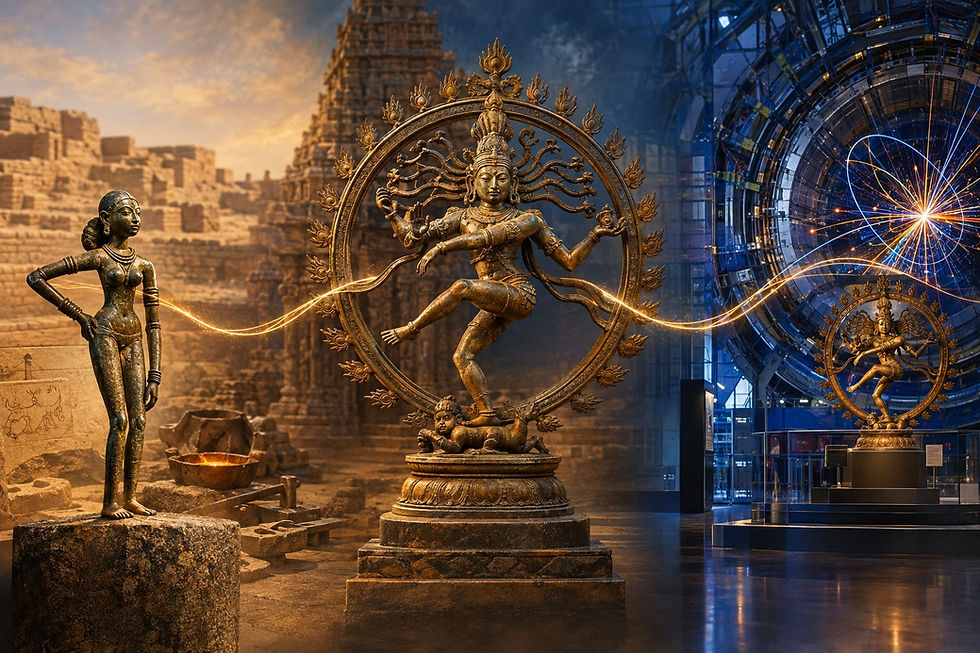
Dancing Girl is a tiny bronze testimony to India’s civilisation's mastery of materials, craftsmanship, artistic imagination and technological knowledge. Her story can be followed across millennia—from the bronze traditions of the Indus Valley, through the extraordinary Chola bronzes, to the Nataraja installed at CERN in Geneva in the twenty-first century.
That is the story I was trying to tell in June.
I am therefore publishing the piece now, not as a belated intervention in an old controversy, but as an attempt to narrate the larger story that the controversies momentarily obscure: in the case of Dancing girl controversy, the story of the remarkable continuity of Indian creativity, craftsmanship, science and imagination. Here is that story, which hopefully connects rather than divides society.
There is an old proverb about "missing the forest for the trees." The recent debate surrounding the image of the Harappan Dancing Girl in an NCERT textbook brought intense attention to questions of representation, propriety and pedagogy. Yet, amid the noise, an extraordinary larger story risked being overlooked.
The tiny bronze figure from Mohenjo-daro is not merely an archaeological artefact or a textbook illustration. It is among the earliest surviving testimonies to India's metallurgical genius, a legacy of craftsmanship and scientific knowledge that stretches across millennia. From the bronze-casters of the Indus Valley Civilization to the master sculptors of the Chola age, and ultimately to the installation of Nataraja at CERN in Geneva on 18 June 2004, one can trace a remarkable metallurgical civilisational continuum, which evidentially stands tall even today at the national capital, Delhi as the rust less wonder, the Delhi Iron Pillar.

Therefore, the real significance of the Dancing Girl, the earliest surviving testimonies to India's mastery of metallurgy, craftsmanship and artistic imagination, must transcend beyond the controversies of its representation in text books to the enduring story she tells about India's ability to imagine, innovate and create.
The bronze figurine, Dancing Girl of Mohenjo-daro, barely eleven centimetres tall, has captivated scholars and laypersons alike since her discovery over a century ago. Standing with one hand on her hip and radiating confidence across four millennia, she remains one of the most iconic images of the ancient world.
What is often forgotten is that this small bronze figure represents the beginning of a civilisational journey that would eventually produce some of the finest metal sculptures ever crafted by human hands — the Chola bronzes of South India. In a remarkable twist of history, the installation of a majestic Chola Bronze Nataraja at CERN in Geneva, the world's premier laboratory for frontiers of fundamental research in particle physics has brought a full circle to the remarkable story of the metallurgical heritage of India.

The story of Indian bronze is therefore is not merely an art historical narrative. It is also a story of science, technology, philosophy and continuity.
The bronze-casters of the Indus Valley Civilisation possessed sophisticated knowledge of metalworking. The lost-wax casting process used in creating the Dancing Girl was a highly advanced technique requiring precise control over materials and temperatures. It demanded not only artistic skill but also a practical understanding of materials and metallurgy. Long before modern laboratories emerged, ancient artisans had mastered complex processes through observation, experimentation and accumulated knowledge.
The significance of this achievement becomes even clearer when viewed across the longue durée of Indian history and through the collections of India's great museums. Visitors to the Bronze Gallery of the National Museum in New Delhi, the celebrated Chola Bronze Gallery of the Government Museum in Chennai, or the Decorative Arts Gallery at the Chhatrapati Shivaji Maharaj Vastu Sangrahalaya (CSMVS), Mumbai, encounter remarkable examples of a metallurgical and artistic tradition that evolved over millennia. At CSMVS, a majestic Nataraja and a replica of the iconic Dancing Girl—currently welcoming visitors to the exhibition “Networks of the Past: A study gallery of India & the Ancient World” (https://networksofthepast.csmvs.in/) symbolically frame this extraordinary journey. Civilisations rise and fall; artistic traditions often disappear. Yet India presents a remarkable example of continuity. Across centuries and changing dynasties, knowledge systems evolved, adapted and flourished, leaving behind a bronze legacy that continues to inspire admiration across the world.
By the ninth century, under the Cholas, bronze casting had reached extraordinary levels of refinement. The Chola sculptors transformed metal into art, aesthetic and poetry. Their bronzes were not static images but embodiments of movement, grace and spiritual energy. Among them, the image of Shiva as Nataraja emerged as one of humanity's greatest artistic achievements.
The Dancing Nataraja is a sculpture, philosophy and cosmology combined.
In the circle of flames surrounding the dancing figure, one encounters the rhythm of the universe itself. Shiva dances creation into being, sustains existence and dissolves it, only for the cycle to begin anew. Every gesture carries meaning. Every movement speaks of cosmic order amidst apparent chaos.
What makes the Nataraja especially remarkable is that it emerged from a civilisation that did not see art and science as separate domains. The same culture that developed sophisticated metallurgical techniques also contemplated profound questions about time, matter, energy and existence.
It is perhaps for this reason that the image found an unexpected home in the twenty-first century at CERN, an international premier scientific institution.
On 18 June 2004, a bronze Nataraja, gifted by the Government of India, was installed at CERN in Geneva. To many observers, the installation appeared surprising. How could an ancient Hindu deity find a place at the world's leading centre for research in particle physics?

Perhaps, apparently, for its symbolism. Modern physics reveals a universe that is dynamic rather than static. At the subatomic level, particles constantly interact, transform and disappear. Matter and energy engage in ceaseless movement. The universe is not a fixed machine but a dance of relationships and transformations.
The Nataraja at CERN is often explained as a metaphor for the dance of subatomic particles, an interpretation popularised by physicist Fritjof Capra and acknowledged on the plaque accompanying the sculpture. That explanation tells only part of the story.
For decades, scientists and thinkers have been intrigued by the parallels — metaphorical rather than literal — between this scientific understanding and the imagery of Nataraja. The statue at CERN does not imply that ancient India anticipated particle physics. Such claims neither serve history nor science. Rather, it acknowledges that different cultures have sought, in their own ways, to comprehend the underlying rhythms of existence.
The Nataraja statue at CERN represents one of humanity's most enduring traditions of metallurgical excellence. It belongs to a tradition whose roots extend back thousands of years.
Between the Dancing Girl of Mohenjo-daro and the Nataraja of CERN lies an unbroken chain of knowledge, skill and creativity. The furnaces may have changed. The patrons may have changed. The contexts certainly changed. Yet the underlying capacity to imagine, innovate and create endured.
This continuity acquires special significance today as India witnesses the return of numerous stolen antiquities from abroad.
Many of the recovered objects are Chola bronzes that had been illicitly removed from temples and communities over decades. Their repatriation represents more than the recovery of valuable artworks. It is the restoration of cultural memory.
For too long, discussions about heritage were often confined to museums, specialists and collectors. Increasingly, however, Indians are beginning to view cultural heritage as an integral component of national identity and confidence. The return of a stolen bronze is not merely a legal or diplomatic achievement. It is a reaffirmation that the creations of previous generations continue to matter.
This renewed appreciation of heritage coincides with a broader national conversation about development. Too often, societies are encouraged to choose between pride in the past and aspirations for the future. One is portrayed as nostalgic, the other as progressive.
India's experience suggests that this is a dishonest choice.
The phrase "Virasat and Viksit Bharat" captures a more balanced vision. A nation does not become modern by forgetting its past. Nor does it honour its heritage by remaining trapped within it. Progress emerges when a society draws strength from its civilisational foundations while engaging confidently with contemporary challenges.
The Nataraja at CERN embodies precisely this synthesis.
The Dancing Girl of Mohenjo-daro, the Chola bronze masters and the physicists of CERN all belong, in different ways, to this larger human story.
Perhaps that is the deeper lesson hidden beneath recent controversies. The significance of the Dancing Girl does not lie merely in how she is depicted in a textbook. Her true importance lies in what she represents: a civilisation capable of transforming metal into art, technique into beauty and knowledge into enduring cultural achievement.
When we look beyond the immediate debates, the forest comes into view.
From the ancient bronze traditions of the Indus Valley to the Chola Bronzes; from the recovery of stolen antiquities to the frontiers of modern physics in Geneva; from Virasat to Viksit Bharat — a single bronze thread runs through the story.
It is a thread woven from creativity, craftsmanship, scientific curiosity and cultural confidence.
And it continues to connect India's past with its future.
Shivaprasad Khened
Shivprasad Khened is a science communicator, museum professional and heritage practitioner with a distinguished career in India’s leading science, art and cultural institutions. He is currently Senior Advisor to the Director General, Chhatrapati Shivaji Maharaj Vastu Sangrahalaya (CSMVS), Mumbai, and a Trustee of the Gandhi Smarak Nidhi, Mani Bhavan, Mumbai. He also serves on the Academic Council of the Maritime History Society.
He has previously served as a Member of the National Council of Science Museums (NCSM) Society, Ministry of Culture, and as Director of the Nehru Science Centre, Mumbai; National Science Centre, Delhi; and Visvesvaraya Industrial & Technological Museum, Bengaluru. He has also served as Director of the National Gallery of Modern Art (NGMA), Mumbai and Bengaluru. A prolific science communicator and curator, he has written extensively and curated numerous exhibitions on science, history and heritage.
P.S. At Meluha Maritime, we believe that understanding India’s maritime heritage also means understanding the wider civilisational traditions that shaped the country’s relationship with knowledge, technology, craftsmanship and the natural world. This week’s Maritime Musings carries Shivprasad Khened’s reflection on that remarkable journey, and on why these connections between art, science and technology continue to matter.
Disclaimer: The views and opinions expressed in this article are those of the author.


Excellent article by Shri S M Khened. Inspiring and a treat to read. His efforts in weaving history with modern concepts is an effort to counter the fake narratives being spread in present time. His articles are as pure as science without and adulteration.