


Book Review: DOWNWIND, FOUR GREEN

Updated: Oct 4
Author's Note
Recent debates surrounding the role and survivability of aircraft carriers in modern warfare, particularly in the aftermath of ongoing operations in West Asia, have sparked debates regarding the relevance of aircraft carriers in an era increasingly shaped by drones, loitering munitions and long-range warfare dominated by precision and standoff capability. In India too, discussions surrounding the need for and the future of aircraft carriers continue to occupy strategic and media discourse alike. It is against this backdrop that “Downwind Four Green" by Vice Admiral Vinod Pasricha (Retd) assumes renewed relevance as a detailed historical account of the origins and evolution of Indian naval aviation. This article is a detailed review of his book and how it is relevant to contemporary maritime discourse.
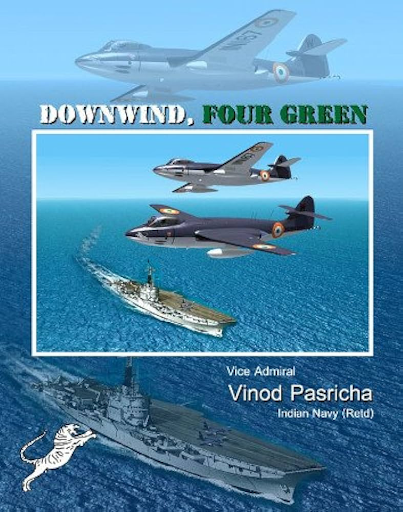
Published in 2010 by Pashmira Publications, Downwind Four Green is both a squadron history of Indian Naval Air Squadron (INAS) 300 “White Tigers” and a broader account of the evolution of Indian naval aviation itself. Despite its limited circulation today, the book stands out for the depth of its research and archival detailing.
Rather than beginning directly with the Hawker Seahawk, Vice Admiral Pasricha traces the origins of the Naval Air Arm to the immediate post-war period and the ambitious “Plan Paper No.1” approved in 1946, which envisaged an Indian Navy equipped with light fleet-escort carriers and a substantial carrier-borne air component. The turbulence of independence, financial constraints and the onset of the Korean War, however, drastically curtailed these plans. As the author demonstrates, the Indian Naval Air Arm emerged from remarkably modest beginnings with the establishment of the Fleet Requirements Unit (FRU) in 1953 operating the Short Sealand amphibians from Kochi. The book interestingly pays much detail to the forgotten “pioneers” of Indian ‘Naviation’ such as Cdr YN Singh, Lt Cdr BD Law and later VAdm MK Roy.
The narrative then follows the gradual evolution of naval aviation through the induction of aircraft such as the Fairey Firefly and de Havilland Vampire before culminating in the acquisition of INS Vikrant and the raising of INAS 300 and INAS 310 in 1961. It is within this wider institutional and operational context that the history of the Seahawk-equipped White Tigers is situated.
A Benchmark in Indian Type Histories
What distinguishes Downwind Four Green from most Indian military histories is its methodological depth. Indian military writing has traditionally focused on wars, personalities, policy and diplomacy, while dedicated “type histories” centred on specific aircraft, platforms or units remain comparatively rare. In this regard, Vice Admiral Pasricha’s work stands among the finest examples of the genre in India.
The book succeeds not merely because of its detail, but because of the breadth of context it provides. Beyond narrating the operational history of INAS 300 and the Hawker Sea Hawk, the author also explores the development of early naval jet aviation, the evolution of carrier operations, training and deck procedures, maintenance practices at sea, and the logistical realities of sustaining a carrier-borne fighter force in an era where very few countries had aircraft carriers and India, despite being an “ economically under-developed country” managed to become the first Asian country to have an aircraft post-WW2. Particularly valuable are the firsthand accounts and interviews woven throughout the narrative, which provide insight into the experiences of naval aviators during the formative decades of the Naval Air Arm.
One of the book’s greatest strengths lies in its treatment of adversity. Rather than presenting an uninterrupted story of institutional success, Pasricha documents the severe budgetary, operational and logistical constraints faced by Indian naval aviation during the 1950s through to the late-1970s. The challenges of sustaining an ageing Sea Hawk fleet well after its retirement from Royal Navy’s Fleet Air Arm (FAA) service, the acquisition of surplus German and Dutch aircraft to maintain fleet strength and maintenance levels, and the difficult operational condition of INAS 300 just a few months shy off’ the 1971 war are examined with notable honesty. The eventual operational success of the squadron during the Bangladesh Liberation War therefore emerges not merely as a combat achievement, but as a testament to institutional resilience and improvisation.
Critique and Observations
If there is one limitation to Downwind Four Green, it lies in its narrative style. Like several institutional naval histories produced in India, the book occasionally adopts a documentary-esqe tone that prioritises recollection and dramatised narration as much as the facts themselves. At times, the strong personalisation of events and anecdotes can blur the distinction between documented history and recollections from personal memory, particularly for readers unfamiliar with the broader historical context of the INAA. That said, these stylistic tendencies do little to diminish the book’s archival, operational and historiographical value, which remains exceptional within the limited corpus of Indian naval aviation literature.
Conclusion
At a time when aircraft carriers are increasingly scrutinised in the context of drone warfare, long-range precision strike systems and evolving maritime doctrine, Downwind Four Green serves as an important reminder that naval aviation cannot be understood purely through technological debates detached from historical experience. One of the book’s most valuable contributions lies in demonstrating how Indian naval aviation evolved under conditions of severe financial, logistical and operational constraint, often relying on improvisation and institutional adaptability to sustain operational capability.
While the Indian Navy that we see today is a much more modernised force and received a lot of support from the Indian Government, the story of INAS 300, INS Vikrant and the Sea Hawk is therefore not merely one of aircraft and carriers, but of the emergence of an Indian maritime mindset shaped by resource limitations and strategic necessity. For historians, naval enthusiasts and students of maritime air power alike, despite the ongoing arguments, it is quite evident that aircraft carriers are deemed to play an important role in India’s Maritime Power project in India’s ‘Amrit Kaal’.
Vice Admiral Pasricha’s work remains one of the most important contributions to Indian naval aviation historiography and deserves far wider circulation than it presently enjoys.
Arjun Prakash Iyer
Arjun Prakash Iyer is a 24 year old Research Scholar under the Unni Kartha Chair of Excellence (UKCOE), chaired by CAPSS. A graduate in Journalism, he studies contemporary defence issues through the lens of military history and is currently researching the role and service history of the MiG-23 and MiG-27 in the IAF. He is also a research associate at Meluha Maritime.
Disclaimer: The views and opinions expressed in this article are those of the author.



Great as always, A remarkably well-researched and insightful review. The effort, clarity, and historical perspective you've brought to this piece are truly commendable. Thank you for shedding light on an often-overlooked aspect of Indian naval aviation history.
A true emerging scholar, Arjun, it sounds great in knowing more facts about aircrafts.. your cherishing attraction since school days and the detailed description keeps the reader informed about the subject.
Keep it up!