


From Birth to Berth: The making of INS Mahendragiri

On July 11, 2026, the Indian Navy commissioned the latest warship in her ‘beda’ (fleet), INS Mahendragiri. This article provides an overview of how exactly a warship is born and commissioned into the Indian Navy, but also a first-hand account of the commissioning ceremony from ground zero, at Visakhapatnam.

So, how is a warship born? It begins, of course, with the design process, a task that requires considerable expertise. India's indigenous warship-building capabilities have evolved significantly since the 1960s and 1970s, when limited funding compelled the Indian Navy to develop indigenous solutions for building and inducting warships. An early milestone was the construction of six Nilgiri-class frigates, based on the British Leander-class. Decades later, the name was revived for Project 17A, a further development of the Shivalik-class stealth frigates, incorporating greater stealth and indigenous content.
Design of Project 17A commenced from around 2013, the class incorporates up to 75% indigenous components and involves over 200 Indian defence manufacturing organisations. The first scale model was unveiled at DefExpo 2018 in Chennai, with seven ships subsequently planned: Nilgiri, Udaygiri, Himgiri, Dunagiri, Taragiri, Vindhyagiri and, the protagonist of our story, Mahendragiri. The sixth of the seven Project 17A frigates, INS Mahendragiri is also the fourth and final ship of the class built by Mazagon Dock Shipbuilders Limited (MDL) in Mumbai.
The journey begins…
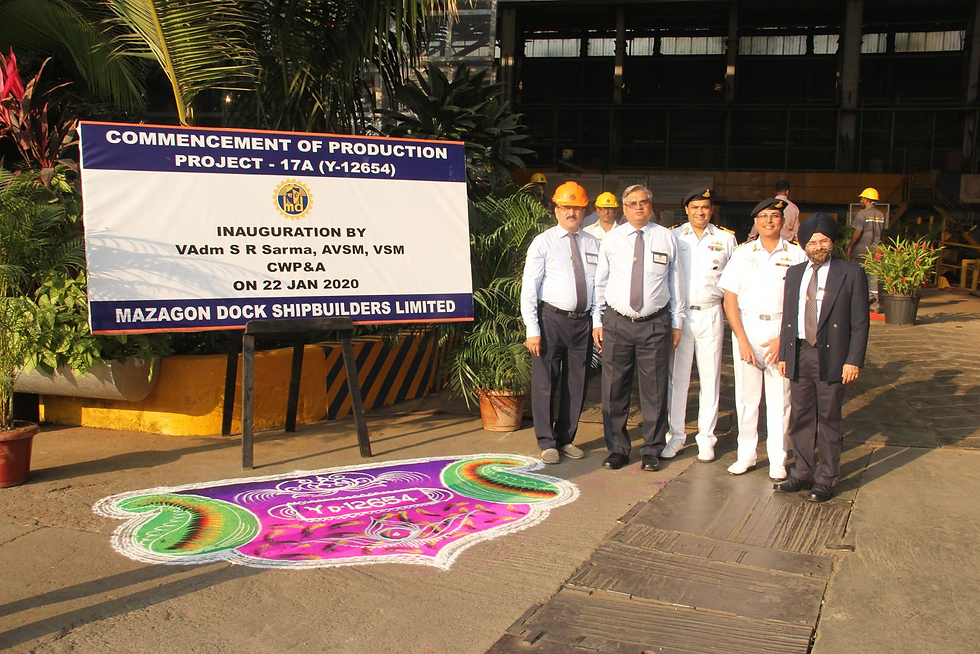
The construction of a warship begins with the commencement of the project, marked by the ceremonial cutting of the first steel. The construction of Mahendragiri commenced on 22 January 2020; with the project being inaugurated by Vice Admiral S. R. Sarma, AVSM, VSM, who was the then Controller of Warship Production and Acquisition (CWP&A). The hull was assigned the Yard Number 12654.
This is followed by keel laying, traditionally symbolising the laying of the ship's 'spine'. While the keel of a ship played a major part in the structural integrity of the ship in a traditional sense, modular construction, wherein sections of a ship are built independently before being assembled, has reduced the keel's structural significance. Therefore, in the case of Project 17A, the keel laying ceremony was in the context of completion of the first section of the hull of the ship. INS Mahendragiri’s keel was laid on 28 June 2022.

Once much of the hull and superstructure has been assembled in a dry dock, the ship is launched, marking the first time she meets the water. The launching of a ship is another big event that is celebrated with great pomp, as it shows the first step in a ship’s life, i.e, to ‘float’. Smt Sudesh Dhankhar, the wife of then Vice President of India Shri Jagdeep Dhankhar, launched Yard Project No. 12654 on 1 September 2023 and the ship eventually christened INS Mahendragiri. The ship takes her name from the Mahendragiri mountain of the Eastern Ghats, and her mascot is the Crested Goshawk.

Once the ship has been successfully ‘launched’, she is then berthed alongside a jetty for 'fitting out', during which her propulsion, sensors, radars and other systems are installed and integrated. As her fitting out nears completion, the ship starts undertaking harbour/basin trials, during which her systems are tested with the help of shore-based facilities, while being berthed to the jetty. Once she completes her HATs, she proceeds to Sea Acceptance Trials (SATs). Part of the SATs also includes a Contractor's Sea Trials (CST), which involve testing the propulsion, speed, manoeuvrability and other basic handling. Once she completes the CST, she undergoes further SATs which evaluate the functioning of her sensors, weapon systems and other capabilities.
In the Indian Navy, a Warship Overseeing Team (WOT) works alongside the shipyard throughout construction before a skeletal naval crew drawn from across the service gradually takes charge of the vessel before her sea trials. This skeletal crew would also go on to be the ships' “commissioning crew”. In the case of INS Mahendragiri, the ship’s crew took over from the WOT sometime in January 2026, under Captain Saikat Chatterjee and the executive officer Commander Praveen Kumar. She left for her first CST on March 5, 2026, and has had the accomplishment of completing her CST in just one sortie!
Upon successfully completing the required trials, the ship is formally delivered to and accepted by the Indian Navy. Commissioning subsequently marks her formal entry into naval service and assignment to a fleet. INS Mahendragiri was accepted into the Indian Navy on April 30, 2026 . She set sail to Visakhapatnam in the last week of May for her commissioning. INS Mahendragiri was commissioned into the Indian Navy on July 11, 2026. The Hon'ble Raksha Mantri, Shri Rajnath Singh graced the event.
What happens after INS Mahendragiri joins the fleet? Even then, her journey is not complete. The ship and her crew undergo post-commissioning trials and a 'work-up' phase before attaining full operational status - completing the long journey from the first cut of steel to a fully operational warship.
The Big Day of Commissioning
The weather on the morning of 11 July was characteristic of Visakhapatnam: hot and humid, yet wonderfully sunny. While most were expecting it to rain because of the season, Lord Indra decided to be more ‘favourable’ to the grand ceremony! The event was held at the Naval Dockyard.
As the shuttle approached the commissioning jetty, I was greeted by a sight that remains etched in my memory.
Berthed adjacent to the commissioning jetty was INS Taragiri, illuminated by the morning sun through the coastal haze. For a moment, I was mesmerised; she appeared almost heavenly and surreal, like something out of a dream. That was the first time that I had come anywhere close to a warship and realised how big and majestic the Project 17A ships were! Unfortunately, photography outside the commissioning jetty was prohibited so the delight of the visual cannot be shared with the readers.
Entering the venue, the first person I greeted was Mahendragiri's Commanding Officer, Captain Saikat Chatterjee, although the packed schedule allowed little time for conversation. The venue itself was filled to capacity. For me, the occasion was particularly special, having spent the preceding two months working on the ship's commissioning booklet. Watching the films showcasing Mahendragiri play before an enthusiastic audience made the moment even more memorable.
Following the arrival of the dignitaries, including the Chief of the Naval Staff and the Hon'ble Raksha Mantri Shri Rajnath Singh, the ceremony proceeded with the Guard of Honour and addresses by the dignitaries. The defining moment came with the reading of the commissioning warrant by Captain Chatterjee, delivered with an unmistakable confidence and air of leadership. As the Naval Ensign and commissioning pennant were raised aboard Mahendragiri, she formally became an Indian Naval Ship.
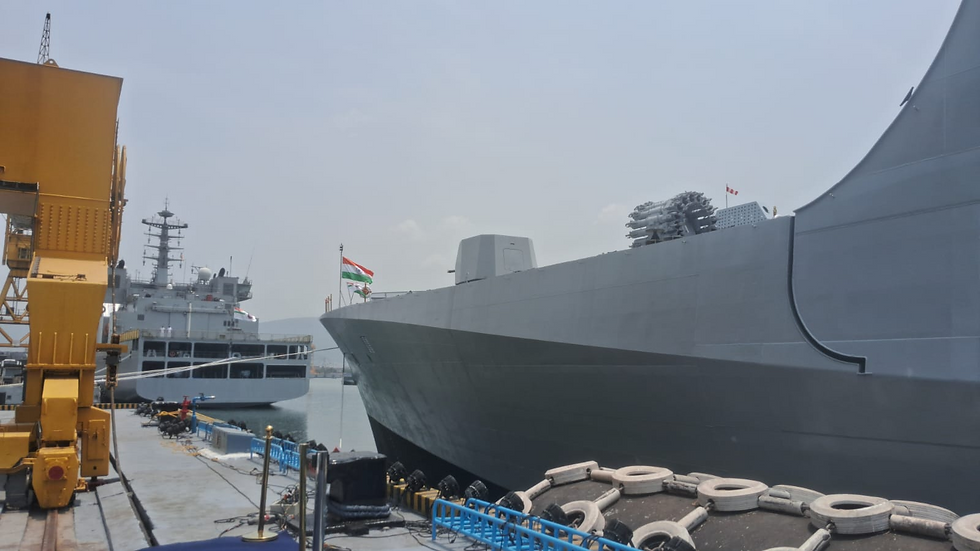


Following the ceremony, I had the privilege of being shown around Mahendragiri and dining with her officers in the wardroom. Standing aboard her offered a perspective that photographs simply could never convey. Up close, one realises the sheer scale of a modern warship and cannot help but feel dwarfed by the vessel around oneself!
Unlike her six Project 17A sisters, whose names carry forward the legacy of the original Nilgiri-class, Mahendragiri begins without a predecessor of her own. Yet, she has already begun creating her own legacy. She completed her sea trials in a single sortie and became the fastest Project 17A frigate to progress from steel cutting to commissioning, completing the journey in under 77 months and surpassing Dunagiri's 80 months. It would be interesting to see if the last ship of the class, INS Vindhyagiri, slated to commission by the end of 2026, would be able to beat this record.
There was something deeply satisfying in witnessing the culmination of that journey, from pieces of steel in a shipyard on India's western coast to a commissioned warship joining the Indian Navy’s ‘Sunrise Fleet’ on the other side of the country. Thus begins another birth: not merely that of a completed ship, but of INS Mahendragiri as a frontline warship. As she and her crew embark upon the decades of service that lie ahead, one can only wish them fair winds and following seas, and many laurels in the service of the Indian Navy and Maa Bharat.
Arjun Prakash Iyer
Arjun Prakash Iyer is a 24 year old Research Scholar under the Unni Kartha Chair of Excellence (UKCOE), chaired by CAPSS. A graduate in Journalism, he studies contemporary defence issues through the lens of military history and is currently researching the role and service history of the MiG-23 and MiG-27 in the IAF. He is also a research associate at Meluha Maritime.


Thank you Arjun for the knowledge I gained through the read.