


Indian Navy on Film: A Raw Deal
- K. V. Ramesh

- Jan 11
- 13 min read
Updated: Jan 12
Such a ponderous title itself should be an indicator that the Indian Navy is grossly under-represented on the Indian screen. This reflects the real-life situation of the Navy in both the pre-independence, and post- independence era. The Navy could be said to truly 'blooded’ in the 1971 Indo-Pak war in a series of daring operations while also showing the perils, with the sinking of the INS Khukri. The Khukri episode would make a great film for all its drama, but then it’s about a ‘loss’ and, probably, few Indian producers would put up huge cash to show a ’tragic outcome’. War films generally are about victories for the home side; it is the adversary that gets overcome.
War films are my special interest as they show how the Armed Forces are represented on screen and whether they mirror reality. As I had written in my 2021 book on Indian war films, Lights Camera War, the “Hindi War Film”, like the regular “Hindi” film caters largely to the Hindi speaking audience, primarily in North India. A pan-Indian appeal is a little difficult for a “Hindi war film”. However, Malayalam and Tamil cinema have bravely forged ahead and made war films where the onscreen characters speak in a mixture of Hindi, English, Tamil or Malayalam, and so on. The ‘Major Mahadevan’ series in Malayalam cinema should have set a new standard but the series grew increasingly unrealistic and bombastic with each successive film, starring Malayalam superstar Mohanlal as Mahadevan.
The cliches in war films comes in truckloads but the most standard clichés and reasons for anyone joining the Armed Forces, in an Indian war film are as below:
Only those who do not have a job/ are good for nothing/ want to prove something.
A love affair gone wrong.
These tropes are especially common for anyone who joins the Army, onscreen. In two or three jump cuts or scenes, the man who was “nothing’ becomes “something” - a serious dedicated Army officer. (Remember Hritik Roshan singing mai aisa kyun hoon and getting the answer after he dons the pips of a Lieutenant in Lakshya). Rarely, are ‘lower ranks’ shown; a ‘star’ always must be an officer. Only Sunil Dutt was shown joining the Army and becoming an ordinary sepoy, the lowest rank in the Army, in the film ‘Usney Kaha Tha’. Since he joined the Army for both the above reasons, he naturally dies in battle. A failed love affair equals battlefield death – onscreen.
Obviously, it begs the question why don’t people with personal problems (as above) join the Air Force or the Navy? Let’s have a slightly humorous answer to that – both the Air Force and Navy are technically oriented services 😊. You can’t just join up and be an officer in three scenes 😊; it will take much longer in real and reel life.
As mentioned earlier, the 1971 war was the one where the Navy truly came of age. There is enough material for war films on both the ‘Western Front’/ the Arabian Sea and the ‘Eastern front’/ the Bay of Bengal. We can only speculate as to why there are few or no war films featuring the Navy. Basically, it’s the sheer quantity of men and material required to shoot the movie, not to speak of manoeuvring the ships in authentic tactical patterns. Army and Air Force allow ample chance for a ‘star/hero’ to single handedly take on multiple enemies and win while in the Navy, the star can’t be a ‘hero’ as every ship is run by a team of officers and sailors.
Here two British examples set in World War 2, should serve as an example. The Battle of River Plate (1956) showed the pursuit and final scuttling of the ‘pocket battleship’ Graf Spee. The actions scenes were a mix of models and real ships. Ships from the Royal New Zealand Navy, the Indian Navy, the US Navy were used in the pursuit scenes. The former HMNZS Achilles which became the INS Delhi, ended up playing herself. Sink the Bismarck! (1960) mostly used models as the Bismarck, like the Graf Spee, had been destroyed in the original battles. Given such difficulties for the western film industry, we cannot but speculate that the Indian film industry chose discretion over valour, in making a film with a naval warfare background.
In such a context, there are very few Hindi/ Indian films with the Indian Navy in the background or as the main story. The below list is surely not a complete list and there will be some misses as there could surely be some obscure films that have Naval background/ scenes set on naval ships. Yet here goes with this list in the chronological order in which they were released, told with some irreverent humour:
1973 - Ek Mutthi Aasmaan
Sudarshan (Vijay Arora) is a naval sailor onboard the INS Vikrant, who always gets into fights with his fellow sailors. The head cook Paapachan (Pran) who Sudarshan calls Paapa Jaan, is the only one who always supports him. On some probing, Sudarshan confesses that he is an orphan with nothing to look forward to even on leave; he has been writing letters to himself to get rid of his loneliness. Paapachan confesses that he too is a lonely man since the time he joined the Navy when he was 15 years old and now has given 23 years of service. This is followed by the Kishore Kumar song har koi chaahta hai ek muthi aasman. This entire introductory scene is set on the INS Vikrant and that is the only Navy connection in the film. The rest of the film is about Sudarshan’s multiple misadventures to find a ‘family’, which he does by the film’s last reel.

Historically, Indian films don’t care too much for reality. For a cook, Pran seems to be having a heavy ‘fruit salad’, the row of ribbons on his left chest. Would the head cook be serving out the food himself? Wouldn’t he be at least a Petty officer after 23 years of service? Nobody cared or questioned since the “Navy section” was very brief and occupied only about 10 minutes of screen time.
1974 – Alingan
This is a typical Hindi film that treats the Armed Forces as part of the problem in the lead couple’s lives. You could even say it’s the third angle of the famous love triangle. Hero. Heroine. Villain. The Navy is the villain here that sends off the poor officer to war 😊. The story is as cliched as they come.
Lt Ashwini Kumar (Romesh Sharma) chases runaway Ritu (Zahira) and woos her over dinners and bike excursions. Just when he promises to marry her, there is a radio announcement of the 1971 war. Off goes Ashwini to war and his ship, the INS Khukri, is sunk. Everyone assumes that Ashwini is dead. Ritu’s stepfather, from whom she had fled earlier, now rapes her. Ritu “goes bad” and is the talk of the town. Ashwini returns from the dead. Now you fill in the blanks as to how the “embrace” of the title happens. Strangely the Navy is not acknowledged in the film; at least the print on You Tube does not have any such acknowledgement.
This is probably the first Indian film, with a Naval officer as the hero and to show the Naval hardware/establishments in some depth. Screenshots are from the film on You Tube and of extremely poor resolution; hence apologies in advance.

Ashwini takes Ritu on his motorcycle to the Western Naval Command Officer’s Mess. They do not dine with other officers but he takes her for a walk around the area. With the sea in the background in these shots, one assumes that this is in the Colaba area.
Later he gets permission to welcome her on board his ship, the INS Beas (but he gets sunk in the INS Khukri. Continuity – where art thou?)

Our hero sails off to war, leaving the heroine weeping. One of the hero’s friends points to the sea and shots of various contemporary naval ships are interpolated of which the clearest shots are of the F143 INS Trishul and the Osa-class missile boat (unknown pennant number).


The INS Khukri does ASW with her three barreled (Limbo) mortars and since the hero is onboard, is sunk. It’s not mentioned how it was sunk but we know that it was torpedoed by the Pakistani submarine PNS Hangor.


Beyond these brief segments, it is a regular film with a hero, heroine, and villain, and lovely songs by Music Director Jaidev which are all wasted. Oh yes – the step father returns on the wedding day with a promise to derail Ashwini and Ritu’s wedding. Do you think he will survive? 😊
1993 – Darr
Darr is the only film till date to show the secretive MARCOS aka MCF – the Marine Commando Force. Who better to portray them than Sunny Deol? He is tasked to rescue a minister’s daughter from a ship. He pilots a Chariot to the ship and the kidnappers don’t see him (how will they? He is Sunny Deol). He proceeds to deal with them – single handed. The kidnappers were nuts to think they could deal with Sunny Deol. He alone is enough to deal with any kind of terror – be it the terrorist kidnappers or super terrorist Rahul who keeps terrorising his lady love Kiran.
In the brief 15-minute segment that has Sunny’s “entry” as a super MARCOS officer, we can see various aspects of the MARCOS such as the Chariot, INS Abhimanyu and how they operate. However they may operate in real life, Sunny Paaji IS enough for everyone. Am I being cynical? Take a look at what follows:


Sunny enters INS Abhimanyu on a Chetak – with the Top Gun theme playing in the background🙄 (Never mind if it’s a tune for the US Navy). He also has para jump wings and the diver badge too. That’s one hell of a guy the terrorists are going to be sorry they met.


He then alights from a Sea King helicopter onto an inflatable and surveys the ship. Yes – the terrorists don’t spot the inflatable.


The inflatable speeds away - after Sunny has entered the Chariot. The Chariot then surfaces at the target ship’s stern and the terrorist obligingly look away.


All this of course happens in broad daylight. He proceeds to wipe them all out, rescues the daughter. Halfway through the remaining MARCOS team lands on the ship by inflatable and chopper. Hmm. Wonder why they even had a team; isn’t he enough? 😊
If you think I am being too cynical, this is to highlight what is essentially wrong with depiction of armed forces on screen. The MARCOS and all special forces usually operate in teams and or pairs. But then Sunny Deol (or ANY OTHER STAR) can’t work with any team mate, because he IS Sunny Deol.
To the best of my knowledge, this is the only Indian film till date to show a MCF officer doing what he is trained for – naval anti-terrorism. The rest of the film does not matter much for this discussion (though Shahrukh Khan and Sunny Deol and Juhi Chawla fans will say otherwise 😊).
2004 – Ab Tumhare Hawale Watan Sathiyo
The film is announced as a dedication to Indo-Pak Friendship 🤣. Really? If this Anil Sharma’s idea of friendship, then we wonder what is his idea of Enmity? Gadar 3? Gadar 4?

The film is the usual bunch of excesses to justify Pakistanis as blood thirsty savages. However, there is one Pakistani subedar who is so moved by the bravery of captured Indian POW Akshay Kumar that he sets him free. Rest of the film is about the usual dastardly Pakistani plots to carry out various terrorist outrages which the central character Amarjeet’s grandson, the laggard turned hero Kunal, prevents.
However, the film has an interesting prologue cum title scene. It shows an amphibious landing titled as “Chittagong, 1971” and the sinking of a warship in the 1971 war. The Army Colonel Amarjeet announces the amphibious landing to be at Cox’s Bazaar. If this is a case of coincidence, then it’s a happy one, as a real-life amphibious landing happened in the 1971 war at Cox’s Bazaar.
There is also a sinking of a warship. The Captain of the ship Captain Vikram is ferrying his father Amarjeet Singh and his troops for the landing when it is torpedoed by a submarine. He turns the table and with a disabled ship, sinks the submarine but that proves fatal for the ship, as the ship has taken on too much water. Vikram gives his life vest to his father and sinks with the ship, somewhat like the captain of INS Khukri, Capt MN Mulla. So, though the coordinates are off by 180 degrees, the sinking does echo the Khukri sinking.
The Eastern Naval Command is thanked at the beginning of the film.

Though the story is set in 1971, the ships are very much late 20th century.
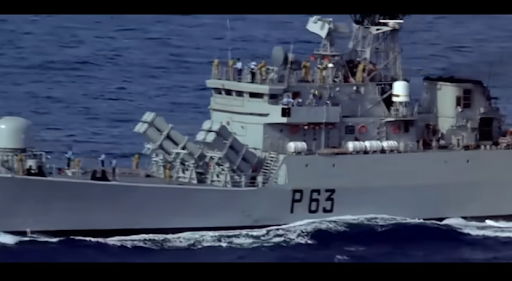


This segment is about ten minutes long and shows the Navy in action, albeit briefly.
2016 – Rustom
What to do about a film like Rustom where one man is enough for the entire legal system? In this case Commander Pawri otherwise known as Akshay Kumar. Despite wearing the wrong labels and uniforms and badges, Pawri does the impossible – proves himself to be innocent of the shooting of a supposed businessman who was – surprise! surprise! – a sleazy arms agent. How do we know he was sleazy? He always has some woman or the other in slinky dresses hanging around his house. His sister is the worst of them all who keeps pouting and smoking like a chimney. Thus, we know the obvious; if the sister is bad then the brother is worse!
This seems to be the argument of this cliché filled ‘legal entertainer’ where Akshay Kumar dominates all scenes. His – I mean Pawri’s insinuation – is that the first aircraft carrier deal for the INS Vikrant, was a rotten one as palms were greased from top to bottom and by shooting the dealer, he put a spanner in the works and has done the nation a favour. Such simpleton logic works against the film which is overwrought and over the top. Additionally, the film makers got all the medals wrong. This photo from the internet proves how much research has been done in the film and the results also seem to be that much flat. He also has the wings of a flier and yet he is shown working on a Cruiser. While flyers can be posted on ships, since this film ostensibly relates to events in the late 1950, when Naval aviation was in its infancy in India, the chances of a Commander rank aviator serving on a Cruiser were slim. Strange are the ways of Bollywood and research is rare.

Also, since this is about Akshay Kumar, he is introduced with a suitable fanfare when he is called to the bridge for the first time, complete with his wings and all ‘ribbons’ intact. This “based on real events” film is a total mishmash and somewhat like the many “legal thrillers’ of the 1950s and 1960s where interminable arguments punctuated with “Objection My (often pronounced me) Lord”, “Order Order” and similar ‘legal’ terms fills the film.
2017 – The Ghazi Attack
At last. A true Naval Film that is full of the Navy from Start to finish. And that too inside a submarine from start to finish. Hats off to the creators.
But wait? Why does the Navy send a second officer to second guess the ‘over aggressive Captain of the submarine? Because the Director has seen the American Film Crimson Tide. Yes. This film is a direct copy of that American film and destroys the concept of an original Indian film, with a Naval background.
The movie was a hit, no doubt due to the original idea of a totally naval film. However, in telling it takes a lot of knocks.

The Foxtrot class submarine S21 is rendered decently by VFX. It’s when the underwater duels are shown that we wonder what the writers were smoking.
The best comment about the proceedings is from the “Pakistani Captain” of the Ghazi who shouts in frustration “is this Indian commander a liftman”? We are expected to believe this wildly improbable story about all the torpedoes of the PNS Ghazi missing the S21 whose torpedoes of course find their mark and destroy the Ghazi.
The creators gave an advance warning before the film that they have taken creative liberty with the facts and history for entertainment purposes, and no disrespect was intended. That’s like a statutory warning on a cigarette pack; if any film maker mentions creative liberty, then we can be certain that they were smoking some high-grade stuff, while writing wildly improbable stories.
That’s the past. But what about the future?
Border 2, is set for release in January 2026. Operation Trident about the Karachi attack was announced but nothing much has been heard till date about its progress. This could be truly a great Naval war film as the Navy proved that it could punch far above its weight and use ships beyond their designed capacity. There is potential for Operation X, where naval divers infiltrated East Pakistan to carry out sabotage. There is even potential for more MCF films. Lt. Arvind Singh’s Maha Vir Chakra in Sri Lanka and the ‘Dadhial Fauj’s’ operations in Kashmiri lakes, could make some exciting action-packed cinema.
Mostly the Indian war film is a losing box office proposition and one with a naval background likely more so. That Ghazi Attack became a hit is surprising despite its many flaws. Maybe Operation Trident will set the ball rolling for the Navy, as it did in real life.
K. V. Ramesh
K. V. Ramesh is a full-time writer and blogger who writes under the pen name Rammesh. A Physics graduate with additional qualifications in Marketing, he brings to his writing the perspective of a seasoned professional, having spent nearly four decades in the biomedical equipment industry. Before retiring, he served as Business Manager for India and the Indian Peninsula region with a German multinational company, and also headed its Training Academy, where he conducted extensive technical training in critical care technologies, particularly ICU ventilators.
Beyond his professional career, Ramesh’s enduring interests lie in cinema, military history, and music—interests that strongly inform his writing. He is the author of three published books that explore themes at the intersection of film and history, and is currently working on his next non-fiction project. He lives in Mumbai with his wife.
Disclaimer: The views and opinions expressed in this article are those of the author alone and do not necessarily reflect the views of Meluha Maritime, its founders, advisors, or affiliates. The article is intended for informational and analytical purposes only and does not constitute official commentary, policy guidance, or an authoritative position on behalf of any institution or organisation.


Nicely articulated
A well curated article. However, would like to add a small clarification. Ghazi/The Ghazi Attack is a Telugu film and it turned into a bilingual film much later into its development. The director, Sankalp Reddy used his own money to construct a submarine set and started working on the film independently. Thankfully, it caught the notice of Rana Daggubati, who used his post Bahubali fame and backed it to be such a fine film, despite being a tad derivative.
Very nice article
A perceptive and timely piece. What it underlines, above all, is that the Indian Navy’s relative absence on screen is not due to a lack of compelling stories, but the difficulty of fitting a fundamentally team-driven, technical service into conventional cinematic templates. Naval operations resist the lone-hero construct, and perhaps that has worked against them in popular storytelling.
That said, there is a quiet sense that this may be changing. With greater institutional support and confidence from the Indian Navy itself, filmmakers could be enabled to tell authentic naval stories without dilution or borrowed idioms. If that support materialises in a sustained manner, it could well pave the way for a new body of work—rooted in realism, professional ethos, and…